
Table of Contents
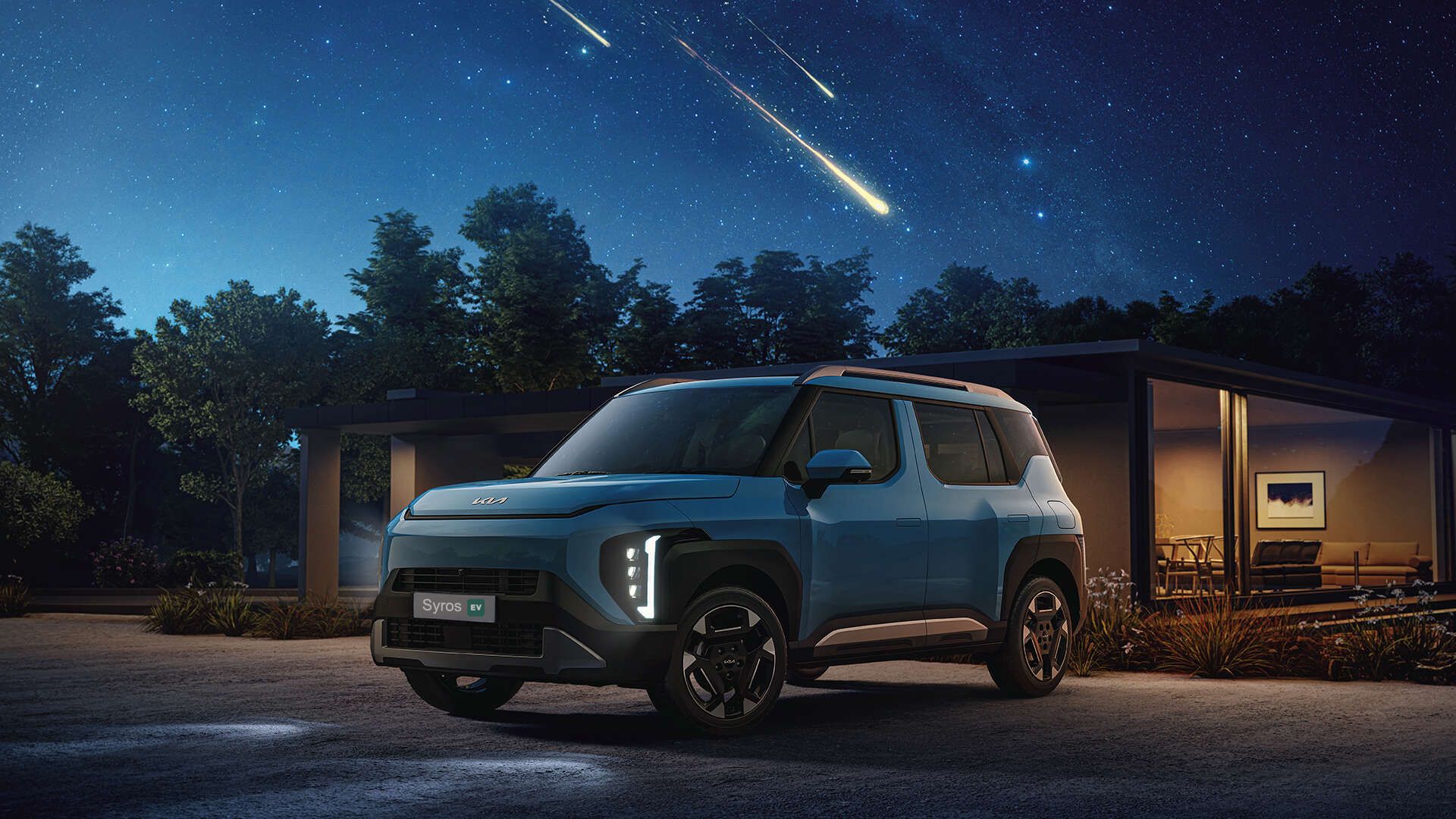
The Kia Syros EV 2026 is one of the most anticipated electric SUVs coming to India this year. Officially confirmed by Kia India for an August 2026 launch, the Syros EV will become Kia’s most affordable electric vehicle in the country and a direct rival to the Tata Nexon EV and Mahindra XUV 3XO EV. Built on the same K1 platform as the already popular ICE Syros, the electric version adds a zero-emission powertrain to one of India’s best-designed sub-4-metre SUVs. If you are planning an EV purchase in the second half of 2026, the Kia Syros EV deserves a very close look.
Overview: Why the Kia Syros EV Matters
The ICE Syros launched in early 2025 and quickly established itself as one of India’s most feature-packed sub-4-metre SUVs, earning a 5-star Bharat NCAP safety rating and bringing segment-first features like Level 2 ADAS, a dual-pane panoramic sunroof, and Kia Connect 2.0 at a starting price of ₹8.41 lakh. The EV version takes that winning formula and adds a fully electric powertrain, targeting the sweet spot of India’s rapidly growing affordable EV market.
What makes the Syros EV especially significant is Kia’s manufacturing commitment to India. Like the Kia EV6 and Kia EV9 which are imported, the Syros EV will be locally manufactured at Kia’s Anantapur plant in Andhra Pradesh. Local production means competitive pricing, faster availability, and better after-sales support — three factors that matter enormously for Indian EV buyers.
Design and Exterior
Based on spy shots and Kia’s official teasers, the Syros EV will closely resemble the ICE Syros in overall silhouette — and that is a good thing. The ICE Syros already has one of the most striking designs in the sub-4-metre segment, with its tall-boy stance, bold character lines, and premium proportions.
The EV-specific changes will be subtle but meaningful. Expect a closed front grille with an illuminated Kia logo, EV-specific aero-optimised alloy wheels, and possibly a distinct colour on the lower body panels to differentiate it from the petrol and diesel variants. The connected LED tail lamps and overall rear design are expected to carry over largely unchanged.
Colour options are expected to include Black, White, and Red at launch, with additional options likely to follow. The Syros’s tall-boy design is particularly practical for Indian road conditions — easy ingress and egress, good headroom, and a high seating position that Indian buyers strongly prefer.
Platform and Battery Options
The Kia Syros EV will be built on the K1 platform, the same architecture underpinning the ICE Syros and shared globally with the Hyundai Inster EV. This platform has been reinforced and optimised for electric powertrains, giving it the structural rigidity needed for battery packaging while keeping kerb weight in check.
India-specific battery specifications have not been officially confirmed yet. However, based on the K1 platform’s global applications and Kia’s parts-sharing strategy with Hyundai in India, the Syros EV is widely expected to be offered with two battery options:
- 42 kWh battery — Expected real-world range of approximately 300–330 km, suited for daily urban commutes in Indian cities.
- 51.4 kWh battery — Expected real-world range of approximately 380–420 km, offering greater flexibility for inter-city travel between cities like Delhi-Agra, Mumbai-Pune, or Bengaluru-Mysuru.
The drivetrain will be front-wheel drive only at launch — a practical decision that keeps costs competitive in a price-sensitive segment. Vehicle-to-Load (V2L) support is also expected, allowing the Syros EV to power external devices — a genuinely useful feature for Indian buyers who travel to areas with unreliable power supply.
Expected Range and Charging
Real-world range in India’s varied conditions — stop-start city traffic, highway speeds, and extreme summer temperatures — typically comes in at 15–20% below official ARAI figures. Based on the expected battery sizes and comparable EVs using similar platforms, here is what Indian buyers can realistically expect:
| Battery | Expected ARAI Range | Real-World Range (India) |
|---|---|---|
| 42 kWh | ~390 km | 300–330 km |
| 51.4 kWh | ~473 km | 380–420 km |
For charging, the Syros EV is expected to support DC fast charging with a 10–80% charge time of approximately 58 minutes on the larger battery. AC home charging via a 7.2 kW wallbox should top the battery overnight comfortably. Kia’s growing Kia Charge network, combined with third-party networks like Statiq, ChargeZone, and Tata Power EZ Charge, ensures reasonable charging availability across Tier 1 and Tier 2 Indian cities.
For most Indian buyers driving under 60–70 km daily — the average for metro city commuters in Mumbai, Delhi, Bengaluru, Hyderabad, and Chennai — even the 42 kWh variant would comfortably last four to five days between charges on home electricity.
Features and Technology
The Kia Syros ICE is already one of the most feature-loaded cars in its segment, and the EV version is expected to carry over most of that equipment while adding EV-specific technology on top. Here is what to expect:
Infotainment and Connectivity
The Syros EV will feature a large touchscreen infotainment display with wireless Apple CarPlay and Android Auto. The Kia Connect 2.0 platform offers 80+ connected features including remote climate pre-conditioning (essential for India’s scorching summers), live vehicle tracking, geofencing, remote battery status monitoring, and over-the-air (OTA) software updates. A digital instrument cluster provides real-time range, energy consumption, navigation, and driving data at a glance.
Comfort and Convenience
Top variants of the Syros EV are expected to offer a dual-pane panoramic sunroof, ventilated front seats, rear ventilated seats, a cooled glove box, wireless phone charging, and an auto-dimming inside rearview mirror. The flexible interior with height-adjustable seating and generous boot space makes it practical for Indian family use. Paddle shifters for regenerative braking adjustment are also expected, allowing drivers to customise their driving experience and maximise range recovery in city traffic.
EV-Specific Features
Beyond the standard feature list, the Syros EV will add EV-specific functionality: multiple drive modes (Eco, Normal, Sport), regenerative braking levels, a dedicated EV energy flow display, charging schedule programming, and the V2L (Vehicle-to-Load) function that lets you power appliances directly from the car’s battery — ideal for camping trips, outdoor events, or as an emergency power backup.
Safety
The ICE Kia Syros earned a 5-star Bharat NCAP safety rating — one of the highest scores in its segment. The Syros EV is built on the same platform and is expected to maintain this safety standard, with the battery pack integrated into the floor adding structural rigidity that typically improves crash performance in EVs.
Standard safety equipment is expected to include 6 airbags, ABS with EBD, Electronic Stability Control (ESC), Hill Hold Assist, TPMS, ISOFIX child seat mounts, and a rear parking camera. The ICE Syros launched with Level 2 ADAS, though Kia quietly removed it in the 2026 model year update. Whether the Syros EV brings ADAS back is one of the most watched decisions for this launch — if it does, it will be a significant differentiator in the segment.
Expected Price and Variants
The Kia Syros EV is expected to be priced between ₹15 lakh and ₹20 lakh (ex-showroom), making it one of the most competitively priced EVs in the compact SUV segment at launch. Multiple variants are anticipated, with the base variant getting the 42 kWh battery and top variants featuring the larger 51.4 kWh pack with the full premium feature set.
| Variant (Expected) | Battery | Expected Price |
|---|---|---|
| Base | 42 kWh | ~₹15 lakh |
| Mid | 42 kWh | ~₹17 lakh |
| Top | 51.4 kWh | ~₹19–20 lakh |
On-road prices in Mumbai and Delhi will be higher by approximately ₹1.5–2 lakh after registration charges, insurance, and applicable state taxes. Kia is also expected to offer attractive finance schemes and corporate/fleet discounts at launch to drive early adoption.
How the Kia Syros EV Compares to Rivals
The Syros EV enters a competitive but growing segment. Here is how it stacks up against its key rivals:
vs Tata Nexon EV 2026: The Nexon EV is the segment benchmark with 489 km ARAI range, 5-star safety, and Tata’s unmatched service network. The Syros EV will need to match it on range and undercut it on features or price to win buyers over. Kia’s stronger brand perception for quality and design could be a decisive factor.
vs Mahindra XUV400 EV 2026: The XUV400 EV offers up to 456 km range and 310 Nm torque from ₹15.49 lakh. The Syros EV is expected to offer a more premium cabin experience and stronger connected car technology.
vs Hyundai Creta Electric: The Hyundai Creta 2026 is a segment above but overlaps at the top of the Syros EV’s price range. The Creta Electric offers a larger cabin, AWD option, and stronger brand recall — but the Syros EV’s more competitive pricing could attract budget-conscious buyers stepping down from the Creta.
Within Kia’s own lineup, the Syros EV sits below the Kia Seltos 2026 and complements the family-oriented Kia Carens 2026, giving buyers a full Kia family across segments.
Should You Wait for the Kia Syros EV?
If you are currently considering an EV in the ₹15–20 lakh bracket and your purchase timeline extends to August–October 2026, waiting for the Syros EV makes sense. Here is why:
- Kia’s build quality is consistently rated above segment average by Indian owners — fit, finish, and long-term reliability are strong suits.
- Kia Connect 2.0 with 80+ connected features is one of the most comprehensive connected car platforms in India.
- 5-star NCAP safety from the ICE platform carries over, making it one of the safest options in the segment.
- V2L support is a genuinely practical feature that few rivals offer at this price point.
- Design — the Syros is widely regarded as the best-looking car in its class, and the EV will retain that appeal.
However, if you need a car before August 2026, the Tata Nexon EV remains the safest, most proven choice in this segment right now.
Verdict
The Kia Syros EV 2026 has all the ingredients to be a landmark product for Kia India and a genuine disruptor in the affordable EV segment. A proven platform, competitive pricing, Kia’s class-leading feature set, strong safety credentials, and the brand’s reputation for quality all point to a compelling package. The August 2026 launch cannot come soon enough for buyers who have been waiting for a premium-feeling, affordable electric SUV from a trusted brand.
Watch this space — we will update this article with official specs, confirmed prices, and a full review as soon as the Syros EV launches in India.
Frequently Asked Questions
When will the Kia Syros EV launch in India?
Kia has confirmed an August 2026 launch for the Syros EV in India, as per its 2026 investor presentation.
What is the expected price of the Kia Syros EV?
The Syros EV is expected to be priced between ₹15 lakh and ₹20 lakh (ex-showroom, India), making it one of the most competitively priced EVs in the compact SUV segment.
What is the expected range of the Kia Syros EV?
Based on the K1 platform and expected battery options, real-world range is estimated at 300–330 km (42 kWh) and 380–420 km (51.4 kWh) in Indian conditions.
Will the Kia Syros EV have AWD?
No — the Syros EV is expected to be front-wheel drive only at launch, keeping costs competitive in the affordable EV segment.
What will the Kia Syros EV compete with?
Its primary rivals will be the Tata Nexon EV 2026, Mahindra XUV400 EV 2026, and the Hyundai Creta Electric at the top of its price range.
Will the Kia Syros EV support fast charging?
Yes — DC fast charging is expected, with a 10–80% charge time of approximately 58 minutes on the larger 51.4 kWh battery. V2L (Vehicle-to-Load) support is also expected.
