
India’s compact SUV segment is one of the most competitive in the world, with over a dozen strong contenders fighting for a buyer’s attention every single month. The Hyundai Creta has led that segment for years — not through a single dominant advantage, but through the consistent execution of everything that Indian buyers value: three engine options, a genuinely premium interior, Hyundai’s comprehensive feature list, and a dealer network that spans every major city and town in the country. Monthly sales consistently between 12,000 and 18,000 units tell the story plainly.
In 2026, the facelifted Creta adds Level 2 ADAS on higher variants, a dual 10.25-inch screen setup, and a voice-enabled panoramic sunroof while keeping the three-engine strategy that makes it the segment’s most versatile choice. This guide covers everything you need to know before deciding.
Table of Contents
- Why the Creta Leads the Segment
- Design and Dimensions
- Three Engine Options Explained
- Performance and Driving Experience
- Interior, Comfort, and Features
- Safety Ratings and ADAS Technology
- Pricing and Variants in 2026
- Ownership Economics
- Honest Pros and Cons
- How It Compares to Rivals
- Who Should Buy the Creta
- Frequently Asked Questions
- Related Posts
Why the Creta Leads the Segment
When the first-generation Creta launched in 2015, it created a template for what a premium compact SUV should look like at an accessible Indian price. It was more premium than anything Maruti offered, more reliable than what many buyers expected from Hyundai at the time, and better-featured than the market had seen in the segment. It set the standard that everyone else has been chasing since.
The second generation and subsequent facelifts have continuously raised the bar — adding the turbo petrol engine, ADAS technology, larger screens, better safety, and a cabin that feels genuinely aspirational rather than merely adequate. Through all of this, the Creta has maintained its core identity: a well-rounded, well-equipped, well-supported compact SUV that doesn’t force buyers to compromise on any single dimension.
Design and Dimensions
The 2026 Creta measures 4,330 mm in length, 1,790 mm wide, 1,635 mm tall, with a 2,610 mm wheelbase. Ground clearance of 190 mm handles Indian urban roads, speed breakers, and typical monsoon flooding comfortably. Boot space of 433 litres is among the best in the compact SUV class, translating into genuine cargo capacity for family road trips and airport runs.
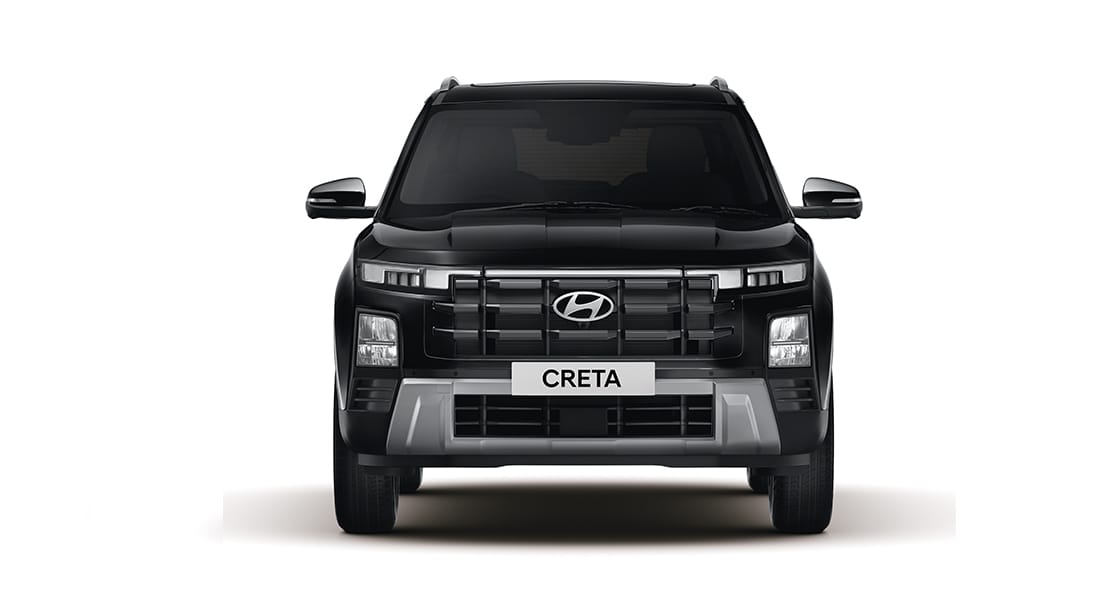
The exterior is bold and contemporary with sharp LED headlamps, a wide H-shaped LED DRL signature, muscular wheel arches, and 17-inch alloy wheels on higher trims. Dual-tone colour options with contrasting roofs on premium variants add visual drama. The overall design communicates premium positioning confidently without being garish — it photographs well and retains its appeal through the model cycle.
Three Engine Options Explained
1.5-Litre Naturally Aspirated Petrol
The 1.5-litre NA petrol produces 115 PS and 144 Nm, available with a 6-speed manual or CVT. ARAI efficiency is 16.8 to 17.4 kmpl. This is the entry and mid-range powertrain — smooth for city commuting, adequate for moderate highway use, and the most affordable running cost in the petrol lineup. Real-world mixed returns typically land at 13 to 15 kmpl.
1.5-Litre Turbo Petrol
The 1.5-litre turbo delivers 160 PS and 253 Nm, paired with a 7-speed DCT automatic. ARAI efficiency is 18 kmpl. The turbo petrol fundamentally changes the Creta’s character — 0 to 100 km/h in approximately 8.5 seconds, genuinely strong mid-range punch for highway overtaking, and a driving feel that engages rather than merely transports. For buyers who want their compact SUV to feel like a genuine performance vehicle as well as a daily driver, this is the engine to choose. Real-world mixed returns typically land at 12 to 15 kmpl.
1.5-Litre Diesel
The diesel produces 116 PS and 250 Nm, with a 6-speed manual or automatic option. ARAI efficiency reaches 21.8 kmpl (manual) and 19.1 kmpl (automatic) — the most fuel-efficient configuration in the lineup. Real-world highway returns of 17 to 20 kmpl make the diesel the right choice for buyers covering 1,500 km or more monthly, particularly those whose driving is predominantly highway or long-distance.
Performance and Driving Experience
The Creta’s suspension is well-tuned for Indian conditions — the ride absorbs broken tarmac, speed breakers, and potholes without the harshness of stiffer rivals, while maintaining highway composure under full load. Steering is light and responsive in urban conditions, weighing up appropriately at speed. The 5.3-metre turning radius makes city manoeuvring accessible despite the Creta’s dimensions.
The turbo petrol DCT combination delivers the most engaging driving experience — quick gear changes, confident acceleration, and a dynamic feel that sets it apart from naturally aspirated rivals. The diesel automatic is the most relaxed highway choice with strong torque and comfortable cruising efficiency. The NA petrol CVT suits buyers who want a smooth, low-effort urban daily driver without performance ambitions.
Interior, Comfort, and Features
The Creta’s cabin sets the segment benchmark for interior quality. Dual 10.25-inch screens — one for the instrument cluster and one for infotainment — with wireless Android Auto and Apple CarPlay, an 8-speaker Bose audio system, a voice-enabled panoramic sunroof, ventilated and powered front seats, dual-zone automatic climate control, wireless charging, and ambient lighting create an interior experience that genuinely challenges vehicles in higher price brackets.
The cabin itself is spacious — the 2,610 mm wheelbase delivers generous rear legroom, front seat comfort is excellent for long journeys with good bolstering and support, and material quality on upper variants involves soft-touch surfaces and leatherette upholstery that feel premium rather than merely acceptable. The large 433-litre boot and 60:40 split rear seats complete a practical, well-considered interior package.
Safety Ratings and ADAS Technology
Six airbags are standard, alongside ABS with EBD, Electronic Stability Control, hill-start assist, tyre pressure monitoring, and a 360-degree camera on upper variants. Higher variants add Level 2 ADAS including lane departure warning, autonomous emergency braking, blind spot warning, rear cross-traffic alert, driver attention warning, and adaptive cruise control — a comprehensive active safety suite that places the Creta in line with the most safety-advanced compact SUVs available in India.
According to a study published in the European Journal of Transport and Infrastructure Research, vehicles equipped with lane departure warning and autonomous emergency braking demonstrate statistically significant reductions in serious collision frequency in both urban and highway driving conditions — validating the real-world benefit of the Creta’s ADAS suite beyond its marketing value.
Research from the Global NCAP programme confirms that six airbags combined with electronic stability control delivers the most consistently effective occupant protection across varied real-world crash scenarios — both features now standard across the Creta lineup.
Pricing and Variants in 2026
The Hyundai Creta is priced from approximately ₹11 lakh (ex-showroom) for the base EX petrol to around ₹20 lakh for the top SX (O) turbo petrol DCT. Mid-range variants span ₹13 to ₹17 lakh, with diesel and turbo petrol options available through the middle and upper trims. On-road pricing adds ₹1.5 to ₹2.5 lakh depending on city and state.
The S+ petrol CVT at approximately ₹14 to ₹15 lakh represents the best features-to-value balance for most buyers. The SX turbo DCT is for buyers who want the most performance and the fullest ADAS suite. The diesel automatic suits buyers whose monthly mileage makes fuel efficiency the primary financial driver.
Ownership Economics
Annual service costs typically run ₹5,000 to ₹8,000 for the Creta — reasonable for a mid-size compact SUV with a turbocharged engine option. Hyundai’s service network spans over 1,400 authorised outlets across India. The standard 3-year unlimited kilometre warranty is extendable. Resale value has consistently held at 70 to 80% after three years, benefiting from the Creta’s strong brand recognition and sustained demand in the used car market.
Honest Pros and Cons
Where the Creta Excels
- Three engine options covering NA petrol, turbo petrol, and diesel in one model
- 160 PS turbo petrol with 7-speed DCT for genuine performance
- Dual 10.25-inch screens and Bose 8-speaker audio on top variants
- 433-litre boot — segment-leading cargo space
- Level 2 ADAS on higher variants
- Voice-enabled panoramic sunroof and ventilated seats
- 70 to 80% resale value after three years
Where It Has Room to Improve
- No factory-fitted CNG option — limits appeal in high-CNG usage cities
- Turbo DCT can feel jerky at low city speeds in certain traffic conditions
- Higher variants push into ₹20 lakh territory where XUV700 and Seltos compete aggressively
- Service costs slightly higher than Maruti alternatives due to turbocharged engine complexity
- Not NCAP tested under the latest 2024–26 protocols for the facelifted model
How the Creta Compares to Rivals
Against the Kia Seltos, the Creta wins on interior premium feel and Hyundai’s service network depth; the Seltos counters with arguably better driving dynamics and its own strong feature set. Against the Maruti Grand Vitara, the Creta wins on performance and interior quality; the Grand Vitara wins decisively on strong hybrid fuel efficiency and running costs. Against the Tata Nexon, the Creta wins on interior premium feel and turbo performance; the Nexon counters with a 5-star safety rating and Tata’s EV ecosystem.
The Mahindra XUV700 is a frequent comparison for buyers considering stretching budget — it offers more features and a 5-star NCAP rating at a higher price, making the Creta the smarter value choice for buyers who don’t need the XUV700’s size and ADAS depth.
Who Should Buy the Hyundai Creta in 2026
The Creta is the right choice for buyers who want the most comprehensively capable compact SUV in India — one that handles urban commuting, highway driving, family road trips, and the occasional rough road without ever feeling out of its depth. It suits buyers who want genuine performance (turbo petrol), maximum efficiency (diesel), or smooth daily comfort (NA petrol CVT) from the same model family, and who value Hyundai’s service network and interior quality.
Choose the NA petrol CVT for relaxed urban use. Choose the turbo petrol DCT for performance and dynamic driving. Choose the diesel automatic for maximum fuel efficiency on high monthly mileage. The Creta is not the top choice for buyers focused purely on running cost minimisation — the Grand Vitara’s strong hybrid is superior there — or for buyers who want the most safety credentials per rupee — the XUV700 makes a stronger argument at a higher price.
Frequently Asked Questions About the Hyundai Creta
What is the starting price of the Hyundai Creta in 2026?
The Hyundai Creta starts at approximately ₹11 lakh (ex-showroom) for the base EX petrol manual. Top variants reach around ₹20 lakh ex-showroom. On-road prices vary by city and state.
Which engine is best for the Hyundai Creta?
The best engine depends on your use. Choose the 1.5-litre NA petrol CVT for smooth urban commuting at the best value. Choose the 1.5-litre turbo petrol DCT for performance and driving engagement. Choose the 1.5-litre diesel automatic for maximum fuel efficiency on high monthly mileage.
Does the Hyundai Creta have ADAS features?
Yes. Higher variants of the 2026 Creta feature Level 2 ADAS including lane departure warning, autonomous emergency braking, blind spot warning, rear cross-traffic alert, driver attention warning, and adaptive cruise control.
What is the boot space of the Hyundai Creta?
The Hyundai Creta offers 433 litres of boot space — among the largest in the compact SUV class. The rear seats fold to expand cargo capacity further for luggage-heavy trips.
How does the Creta compare to the Kia Seltos?
The Creta and Seltos share mechanical underpinnings and compete closely. The Creta typically wins on interior feel and Hyundai’s service network breadth; the Seltos wins on driving dynamics and its design character. Both are strong choices — the decision often comes down to styling preference and dealer proximity.
Related Posts
- Kia Seltos 2026: The Compact SUV That Refuses to Compromise
- Maruti Suzuki Grand Vitara 2026: The Hybrid SUV That Rewrites Running Costs
- Mahindra XUV700 2026: India’s Most Feature-Packed SUV Reviewed
- Tata Nexon EV 2026: India’s Most Trusted Electric SUV Reviewed
- Maruti Suzuki Brezza 2026: India’s Best-Selling Compact SUV Reviewed
