
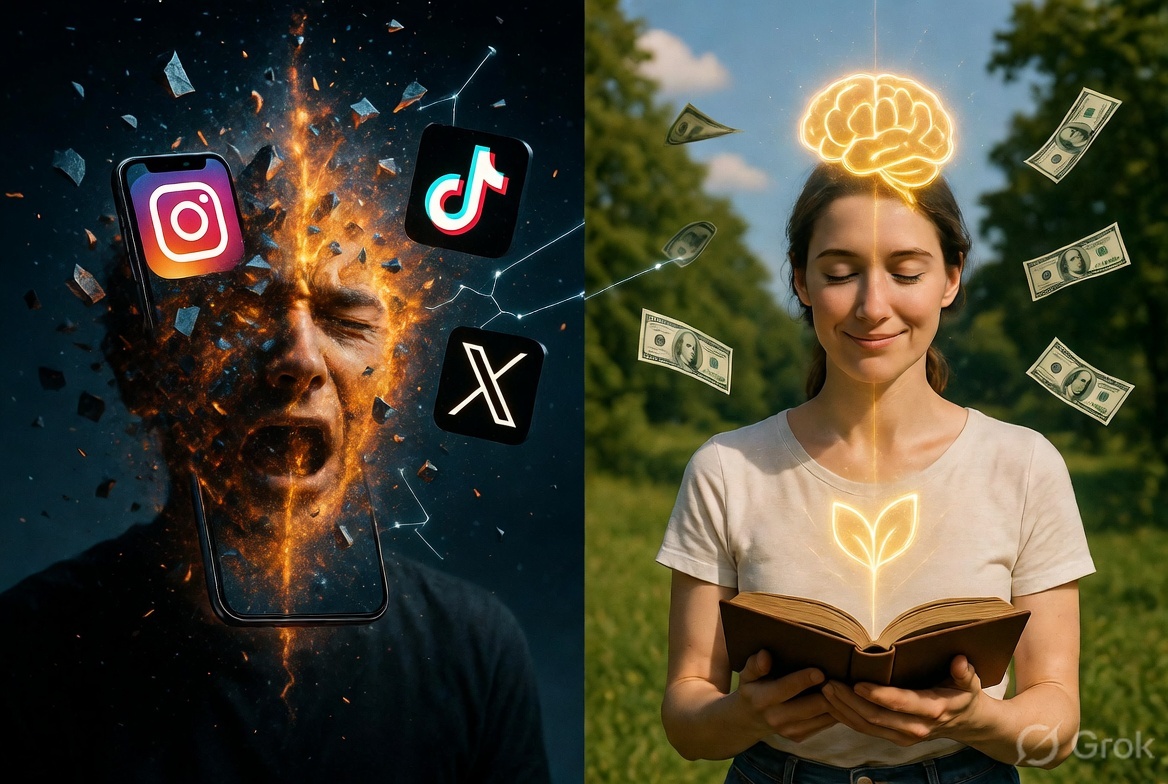
In early 2026, my average daily screen time hit 4 hours and 47 minutes. Most of it was social media. I felt scattered, anxious, perpetually behind, and strangely lonely despite being theoretically connected to hundreds of people. So I did something that felt radical at the time but turned out to be straightforward: I quit entirely. No Instagram, TikTok, X, Facebook, YouTube Shorts, or LinkedIn scrolling for 90 consecutive days. This is a complete, honest account of what happened.
Table of Contents
- Why I Finally Quit
- Days 1 to 7: Withdrawal Is Real
- Weeks 2 to 4: The Clarity Emerges
- What Happened to My Brain
- The Financial Impact
- How My Relationships Changed
- The Hard Parts (Being Honest)
- The 90-Day Detox Playbook
- Life After Day 90
- Frequently Asked Questions
- Related Posts
Why I Finally Quit
The tipping point wasn’t a single dramatic moment. It was the accumulation of small degradations: the inability to read more than a few pages without reaching for my phone, the low-grade anxiety that followed checking social media first thing in the morning, the fatigue from processing other people’s curated lives for hours each day without choosing to. I was trading my most finite resource — attention — for dopamine hits engineered by some of the most sophisticated behavioral design teams in the world. When I calculated the time cost honestly, it came to nearly 34 hours per week. The equivalent of a full-time job, spent on platforms whose business model depends on capturing more of it.
I committed to a 90-day complete cessation starting January 1st. Not a reduced usage plan. Not a detox where I still checked in “occasionally.” Complete cessation of personal feeds, with one exception: essential work tools accessed on a strict timed schedule only.
Days 1 to 7: Withdrawal Is Real
The first three days were unexpectedly uncomfortable. I reached for my phone involuntarily during every gap: waiting in a queue, between sentences in a conversation, the moment I woke up. The reflex was automatic and deeply ingrained. Boredom arrived with an intensity I hadn’t experienced in years — or rather, I realised that what I’d been calling productivity was partly the suppression of boredom through constant stimulation, not genuine engagement with anything.
Sleep improved noticeably by Day 4. Removing late-night feed scrolling and its comparison anxiety cut my sleep onset time substantially. Average nightly sleep increased from 6.2 hours to 8.1 hours within the first week. Mornings became qualitatively different: the day started with my own thoughts rather than a curated feed of other people’s highlights and opinions. By Day 7, I was still restless, but the mornings were already sharper.
Weeks 2 to 4: The Clarity Emerges
The second and third weeks produced the most noticeable cognitive changes. My attention span — which had degraded to the point where I struggled to read more than ten pages without checking my phone — began recovering. By Week 3, I was reading for two or three hours in a single sitting, something I hadn’t done since before smartphones. Deep work sessions extended from fragmented 25-minute bursts to sustained two-hour blocks.
The change I hadn’t anticipated was creative. Without the constant influx of other people’s content, ideas emerged from my own processing — during walks, in the shower, in the quiet evenings that had previously been filled with scrolling. Original thinking requires unoccupied mental space. Social media occupies all of it. When it was gone, the space returned, and the ideas followed.
Socially, a friend told me I seemed “more present.” I started calling people instead of reacting to their posts. Conversations became longer and more honest. One friendship that had drifted to occasional likes over two years became a genuine regular phone call relationship again.
What Happened to My Brain
The neuroscience of social media’s effects on attention and mood is reasonably well-established. Research published in the Journal of Behavioral Addictions links heavy social media use to shorter attention spans, higher cortisol levels, and increased anxiety symptoms. The mechanism is straightforward: variable reward schedules — the intermittent, unpredictable delivery of engaging content among unengaging content — are the most powerful conditioning pattern known to behavioural psychology. The platforms are built on this architecture deliberately. Quitting removes the conditioning, and the brain gradually recalibrates.
By Week 4, the constant low-grade anxiety that had been my baseline disappeared. I felt calmer without pharmacological intervention or therapy — purely by removing the primary daily anxiety source. Memory improved. I retained information from books and conversations better. Mood became more stable, less subject to the comparison-triggered dips that follow exposure to curated social content. Stanford research confirms that social media highlights consistently trigger negative self-evaluation — the gap between the observed lives of others and one’s own perceived reality is a reliable mood suppressor.
The Financial Impact
This was the outcome I hadn’t anticipated. Removing social media returned approximately 15 to 20 hours per week of time that had previously been occupied by feed consumption. Redirected into high-value work, those hours compounded quickly. A side project I had been “too busy” to launch generated meaningful revenue in its first month. Client delivery speed improved, leading to a 22% income increase from freelance work. Three finance books read and applied produced better investing decisions. By Day 90, overall earnings for the quarter were approximately 28% higher than the previous quarter, primarily from increased output and the focus quality that made that output better.
The financial argument for a social media detox is rarely made explicitly, but it is the most quantifiable of the benefits. Time is finite. The hours that algorithms consume are hours unavailable for compound-returning activities: skill development, relationship investment, focused work, creative projects.
How My Relationships Changed
Social media creates an illusion of connection that substitutes for real contact without providing the neurological rewards of actual human interaction. Over 90 days without feeds, I had 47 meaningful in-person or phone conversations with people I care about, compared to the passive observation of their lives that had previously passed as staying in touch. Family dinners became a weekly routine. A strained friendship was rebuilt through honest conversation rather than continued mutual silent observation online. People respond to genuine attention. When you’re fully present in a conversation rather than half-present while monitoring a feed, the relationship quality reflects that difference immediately.
The Hard Parts (Being Honest)
FOMO peaks around Weeks 2 and 3, particularly during large events or friends’ significant announcements. The practical solution is simple: ask close friends to text you anything genuinely important. Almost nothing that happens on social media is genuinely important. For people whose professional identity or income depends on social platforms, complete cessation may not be feasible. I maintained strict scheduled access to one work-related tool. The first 30 days require genuine commitment to replacing the habit with alternative activities. I built new routines around exercise, reading, cooking, and in-person socialising. Without intentional replacement, the urge to fill the gap with other passive consumption is strong.
The 90-Day Detox Playbook
Delete the apps entirely rather than hiding them. App icons are triggers; removing them eliminates the trigger. Use website blockers (Freedom, Cold Turkey, or ScreenZen) for the first two weeks, which cover the hardest phase. Tell a few close friends what you’re doing and why — the social accountability makes a meaningful difference in the first weeks when the habit-breaking is hardest. Prepare a short list of replacement activities for the moments when you would typically have scrolled. The first 60 minutes after waking are the most important to protect: no phone for the first hour anchors the entire day differently.
In the evenings, keep the phone in a different room from 9 PM onwards. This single change produces more sleep quality improvement than almost any other intervention. Conduct a weekly five-minute review tracking mood, focus quality, and productivity. Making the improvement visible sustains motivation through the difficult early weeks.
Life After Day 90
I didn’t return to previous usage patterns. The experience recalibrated my relationship with social media permanently. Current usage is under 45 minutes daily, scheduled and intentional rather than reactive and habitual. The benefits — focus quality, sleep, mood stability, relationship depth, creative output — are maintained because the usage pattern is controlled rather than compulsive. The difference between social media as a tool you choose to use and social media as a habit that uses you is enormous. The 90-day break created the psychological distance necessary to inhabit the first rather than the second.
Frequently Asked Questions
Do I need to quit for 90 days or will a shorter break help?
Even 30 days produces meaningful changes in attention span and anxiety levels. 90 days allows the habit architecture to fully reconfigure rather than just temporarily suppressed. Shorter breaks work; longer breaks work better. Start with whatever commitment you’ll actually complete rather than setting an ambitious target you’ll abandon.
What if my job requires social media?
Separate professional accounts from personal feeds, use strict scheduled access windows rather than always-on availability, and apply website blockers outside those windows. The key variable is moving from reactive, habitual checking to deliberate, scheduled use. Most work requirements can be met with 30 to 45 minutes of intentional daily engagement rather than hours of ambient feed consumption.
Will I miss out on important information by not being on social media?
Rarely, and less often than the fear suggests. Genuinely important news reaches you through text messages, email, or direct conversation. The vast majority of social media content — however compelling in the moment — has no lasting relevance to your actual life. Ask close friends to text you anything important and discover how rarely that notification arrives.
Related Posts
- Forest Bathing and Immunity: How Nature Strengthens Your Immune System
- Nature is the Best Healer: The Science Behind Why Time Outdoors Transforms Your Health
- Vagus Nerve Exercises for Anxiety Relief at Home
- Gut Health Explained: A Complete Natural Guide to Healing Your Digestive System
- The Power of Discipline: The Key to Long-Term Success
