
Table of Contents
India’s largest carmaker has finally gone electric — and the wait was worth it. The Maruti Suzuki e Vitara, launched on 18 February 2026, is Maruti Suzuki’s first-ever battery electric vehicle and one of the most significant EV launches in Indian automotive history. Sold through Maruti’s premium NEXA dealership network, the e Vitara is a ground-up, born-electric SUV built on Suzuki’s Heartect-e platform, co-developed with Toyota. It is priced from ₹15.99 lakh to ₹20.01 lakh (ex-showroom) and offers up to 543 km ARAI-certified range — making it one of the most compelling EVs on sale in India today.
Overview: Maruti Finally Goes Electric
For years, Maruti Suzuki was criticised for its cautious approach to electrification, focusing instead on hybrids and CNG. The e Vitara changes all of that in one bold move. This is not a converted petrol car with a battery — it is a purpose-built EV on a dedicated skateboard platform, engineered from the ground up for electric mobility. Co-developed with Toyota (which sells the same vehicle as the Urban Cruiser Ebella), the e Vitara benefits from Suzuki’s expertise in lightweight construction and Toyota’s EV engineering pedigree.
What makes the e Vitara especially significant for Indian buyers is Maruti’s unparalleled service network. With over 4,000 NEXA and Arena service centres across India — covering every Tier 1, Tier 2, and many Tier 3 cities — ownership anxiety is minimised like no other EV brand can offer. For buyers in smaller cities like Nagpur, Coimbatore, Jaipur, or Lucknow, Maruti’s service reach is a decisive advantage.
The e Vitara is manufactured at Maruti Suzuki’s Hansalpur plant in Gujarat, with Maruti also planning to ramp up production significantly to meet strong initial demand.
Design and Exterior
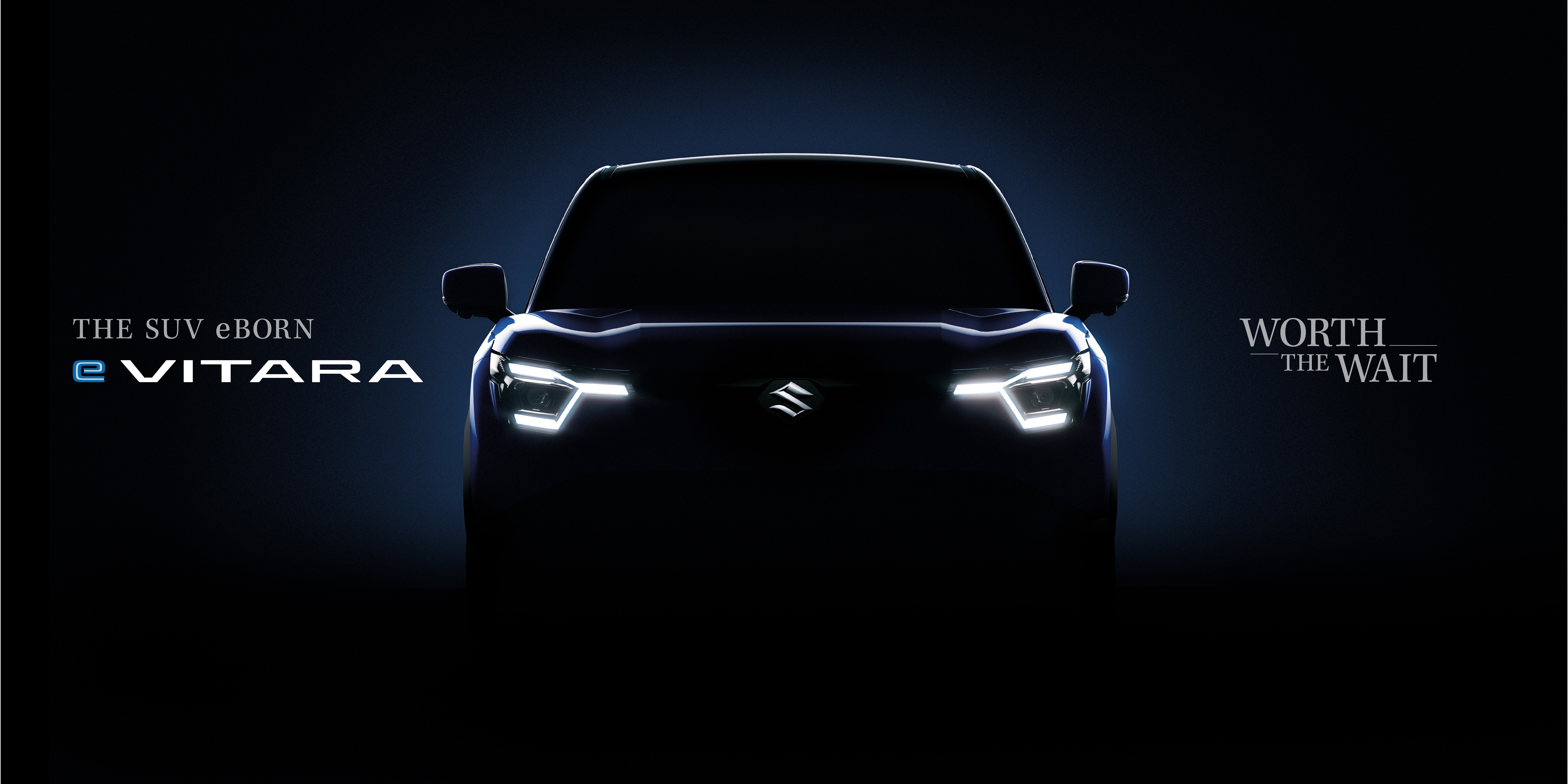
The e Vitara’s design is a clean break from Maruti’s conservative styling history. The front features a blanked-off grille flanked by LED headlights with a distinctive Y-shaped DRL signature — giving it an assertive, modern face instantly recognisable on Indian roads. The bonnet has sharp, sculpted lines that flow into a well-proportioned body with bold lower-door cladding and pronounced wheel arches that convey a rugged, adventurous character.
The side profile is clean and aerodynamic, with a gently tapering roofline and purposeful 18-inch aero-efficient alloy wheels (upgraded to 19-inch diamond-cut alloys on the top Alpha variant). At the rear, a sleek bumper and well-integrated tail lamps complete a cohesive design. The e Vitara is available in 10 colour options including Nexa Blue, Opulent Red, and Grandeur Grey, with four dual-tone combinations featuring a Bluish Black roof — offering excellent personalisation for Indian buyers.
Dimensions: 4,275 mm length, 1,800 mm width, 1,640 mm height, 2,700 mm wheelbase — giving it a spacious cabin footprint in a compact SUV body.
Battery Options and Real-World Range
The e Vitara is offered with two LFP (Lithium Iron Phosphate) battery options:
- 49 kWh battery — Base Delta variant. Motor: 144 hp / 189 Nm, FWD. ARAI range: 440 km. Real-world Indian range: ~320–360 km.
- 61 kWh battery — Zeta and Alpha variants. Motor: 174 hp / 189 Nm (FWD) or 300 Nm (AWD). ARAI range: 543 km. Real-world range: ~420–450 km.
| Variant | Battery | Drivetrain | ARAI Range | Real-World Range |
|---|---|---|---|---|
| Delta | 49 kWh | FWD | 440 km | ~320–360 km |
| Zeta | 61 kWh | FWD | 543 km | ~420–450 km |
| Alpha | 61 kWh | FWD / AWD | 543 km | ~420–450 km |
A standout achievement: the e Vitara is the first electric SUV in India under ₹25 lakh to offer AWD — through Maruti’s ALLGRIP-e system featuring independent front and rear eAxle motors with a dedicated Trail Mode for off-road scenarios. This makes it a genuine all-weather, all-terrain proposition for Indian buyers in hilly regions or those who want extra confidence during the monsoon season.
LFP battery chemistry ensures excellent thermal stability in India’s extreme summer heat (Delhi, Hyderabad, Chennai regularly see 40°C+) and long cycle life of 3,000+ charge cycles for lasting ownership value.
Charging
The e Vitara supports both AC and DC fast charging. Maruti offers a complimentary 7.4 kW AC home charger with every e Vitara — a strong ownership sweetener that reduces the total cost of EV adoption. With the 7.4 kW home charger, the 61 kWh battery charges fully in approximately 8–10 hours overnight.
DC fast charging enables the 61 kWh battery to charge from 10–80% in approximately 45–50 minutes. The e Vitara is compatible with all major Indian public charging networks — Statiq, ChargeZone, Tata Power EZ Charge, and Ather Grid — ensuring coverage across Indian expressways, malls, and commercial hubs. Maruti’s own growing charging infrastructure at NEXA service centres adds further convenience.
The battery is backed by an 8-year warranty retaining 70% capacity, providing long-term peace of mind for Indian buyers concerned about long-term battery degradation.
Features and Technology
Infotainment and Connectivity
The e Vitara features a dual-screen setup comprising a 10.1-inch central touchscreen and a digital instrument cluster. Wireless Apple CarPlay and Android Auto come standard on mid and top variants. The connected car platform supports remote climate pre-conditioning — essential for cooling the cabin on a hot summer day in Mumbai, Bengaluru, or Hyderabad before you get in. A two-spoke steering wheel with mounted controls adds to the clean, modern interior feel.
Comfort and Convenience
The top Alpha variant adds a large fixed panoramic glass roof, ventilated front seats via a 10-way power-adjustable driver’s seat, wireless phone charging, and a cooled glove box. The cabin layout is clean and minimalist with square-shaped air vents that give it a premium feel. Level 2 ADAS is available on the e Vitara — making it one of the most safety-advanced EVs at this price point, with adaptive cruise control, lane keep assist, and autonomous emergency braking.
EV-Specific Features
Multiple drive modes (Eco, Normal, Sport), adjustable regenerative braking, and an EV energy display are standard. The AWD ALLGRIP-e system adds Trail Mode with selective braking and torque distribution for genuine off-road capability. Top speed is electronically limited to approximately 160–180 km/h, and 0–100 km/h is brisk at under 8 seconds on the 61 kWh variants. Under the BaaS (Battery-as-a-Service) programme, the base Delta is available for ₹10.99 lakh with a ₹3.99/km battery subscription fee.
Safety
The e Vitara has received a 5-star Bharat NCAP safety rating — a strong result that validates the Heartect-e platform’s structural integrity. The reinforced high-voltage safety structure provides excellent protection in both frontal and side impacts. Standard safety equipment includes 6 airbags, ABS with EBD, ESC, Hill Hold Assist, TPMS, ISOFIX, and a rear parking camera. Level 2 ADAS on top variants adds a further layer of active safety technology.
Maruti Suzuki e Vitara 2026: Variants and Prices
| Variant | Battery | Ex-Showroom Price |
|---|---|---|
| Delta 49 kWh | 49 kWh FWD | ₹15.99 lakh |
| Zeta 61 kWh | 61 kWh FWD | ₹17.99 lakh |
| Alpha 61 kWh | 61 kWh FWD/AWD | ₹19.79–20.01 lakh |
On-road prices vary by state. In Delhi, the top Alpha variant is available for approximately ₹21–22 lakh after registration and insurance. Maruti also includes a complimentary 7.4 kW home charger with every purchase — saving buyers ₹30,000–50,000 on home charging setup. Under BaaS, the Delta is available from ₹10.99 lakh with a ₹3.99/km battery fee.
How the Maruti e Vitara Compares to Rivals
vs Hyundai Creta Electric: The Creta Electric is the segment benchmark. The e Vitara matches it on claimed range (543 km), offers AWD at a competitive price, and adds Maruti’s larger service network. The Creta Electric has a slight edge on cabin refinement and brand recall in the premium space.
vs Tata Nexon EV 2026: The Nexon EV is more affordable at ₹13–18 lakh with India’s most established EV service network. The e Vitara wins on range (543 km vs 489 km), AWD availability, and a more premium NEXA cabin experience.
vs Toyota Urban Cruiser Ebella 2026: Identical platform and specs, but the e Vitara costs ₹3–4 lakh less. For most buyers, the e Vitara is the better value proposition; Toyota buyers pay a premium for the brand and its resale advantage.
vs Mahindra XUV400 EV 2026: The XUV400 EV starts at ₹15.49 lakh but has lower range and no AWD option. The e Vitara’s stronger range and AWD give it a clear edge at a similar price point.
Should You Buy the Maruti Suzuki e Vitara?
The e Vitara is an excellent choice for:
- Maruti loyalists who trust the brand’s service network above all else and have been waiting for a Maruti EV.
- Buyers in smaller cities where Maruti’s 4,000+ service centres provide unmatched coverage compared to any rival.
- AWD seekers on a budget — the Alpha AWD at ~₹20 lakh is India’s most affordable AWD electric SUV.
- Range-conscious buyers who want 400+ km real-world range and the confidence of India’s most trusted car brand.
- First-time EV buyers who want the reassurance of Maruti’s aftersales ecosystem with the free home charger sweetener.
The Tata Nexon EV remains a strong alternative at a lower price with an even larger EV service network. And the Tata Harrier EV offers more cabin space and longer range for buyers with a higher budget.
Verdict
The Maruti Suzuki e Vitara 2026 is a landmark product for Indian EV buyers. India’s most trusted car brand has delivered a well-engineered, feature-rich electric SUV with class-leading range, AWD availability, Level 2 ADAS, a 5-star NCAP rating, a free home charger, and Maruti’s unbeatable service network — all at a price that makes strong financial sense. The Zeta 61 kWh at ₹17.99 lakh is the sweet spot, offering the larger battery, excellent real-world range of 420–450 km, and most of the key features without paying the Alpha premium.
Frequently Asked Questions
What is the price of the Maruti Suzuki e Vitara in India?
The e Vitara is priced from ₹15.99 lakh (Delta 49 kWh) to ₹20.01 lakh (Alpha 61 kWh dual-tone) ex-showroom. Under BaaS, the Delta starts from ₹10.99 lakh + ₹3.99/km battery fee.
What is the real-world range of the Maruti e Vitara?
The 49 kWh Delta offers ~320–360 km real-world range. The 61 kWh Zeta and Alpha deliver 420–450 km in Indian conditions, against an ARAI-certified 543 km.
Does the Maruti e Vitara have AWD?
Yes — the Alpha 61 kWh variant offers AWD via Maruti’s ALLGRIP-e system with independent front and rear eAxle motors, including a Trail Mode for off-road use.
Does the Maruti e Vitara have ADAS?
Yes — Level 2 ADAS is available, including adaptive cruise control, lane keep assist, and autonomous emergency braking. It is among the first EVs in India under ₹25 lakh to offer Level 2 ADAS.
How fast does the Maruti e Vitara charge?
DC fast charging: 10–80% in ~45–50 minutes. Home charging via the complimentary 7.4 kW AC charger: full charge in ~8–10 hours overnight.
Is the Maruti e Vitara the same as the Toyota Urban Cruiser Ebella?
Yes — both share the Heartect-e platform, LFP batteries, and core specs. The e Vitara is priced ₹3–4 lakh less and sold through Maruti’s NEXA network, while the Ebella carries Toyota’s badge and dealer network premium.
