Three terms dominate almost every conversation about modern technology: artificial intelligence, machine learning, and deep learning. They appear in news articles, job postings, product descriptions, and investment pitches, often used interchangeably as though they mean the same thing. They do not. Each term refers to something specific, and understanding the distinctions between them transforms a confusing landscape of buzzwords into a clear, logical structure that is genuinely easy to understand.
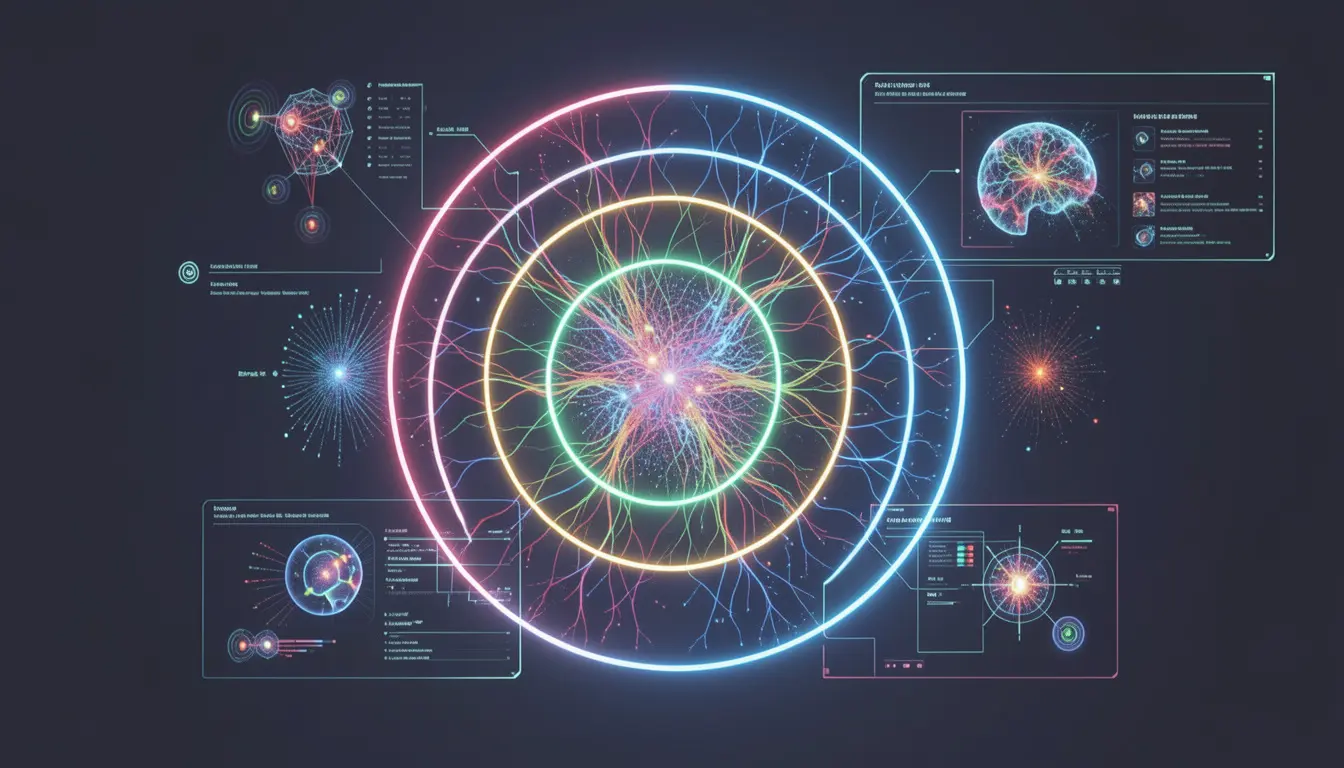
The relationship between these three concepts is best understood as a set of nested circles. Artificial intelligence is the largest circle — the broadest concept, the overarching field. Machine learning sits inside that circle, a specific approach to achieving artificial intelligence. Deep learning sits inside the machine learning circle, a specific technique within machine learning. Every instance of deep learning is machine learning. Every instance of machine learning is artificial intelligence. But not every form of AI uses machine learning, and not every machine learning system uses deep learning.
This nesting relationship is the key to understanding all three concepts and how they relate to the AI-powered world you interact with every day.
Table of Contents
Artificial Intelligence: The Broadest Concept
Artificial intelligence, in its most fundamental sense, is any technique that enables machines to mimic human intelligence. The goal of AI is to create systems that can perform tasks that would normally require a human mind — tasks involving perception, reasoning, learning, planning, language understanding, and decision-making.
What is important to understand is that this definition does not specify how those tasks should be accomplished. AI is a goal, not a method. Throughout the history of AI research, many different methods have been proposed and developed, and machine learning is just one of them — albeit by far the most successful one in recent decades.
Early AI researchers in the 1950s and 1960s pursued a very different approach called symbolic AI or rule-based AI. The idea was to program computers with explicit logical rules that represented human knowledge. A medical diagnosis system, for example, might contain thousands of hand-written rules derived from expert doctors — if the patient has symptom A and symptom B but not symptom C, then consider condition X. These systems could be impressively capable within narrow domains. They were also brittle, expensive to build, and unable to handle the full complexity and ambiguity of the real world.
Other early AI approaches included search algorithms — systems that could explore vast spaces of possible moves in games like chess by calculating ahead many steps and evaluating positions. These systems worked well for structured problems with clear rules but failed completely when applied to the messy, open-ended problems of real human life.
AI is therefore best understood as the field — the scientific and engineering discipline — dedicated to building machines that exhibit intelligent behavior. Machine learning and deep learning are the most powerful tools that field has developed, but they exist within a broader historical and conceptual context.
Machine Learning: Teaching Computers to Learn From Data
Machine learning emerged as a distinct discipline in the 1980s and 1990s, driven by a fundamental insight: instead of programming computers with explicit rules, what if we gave them data and let them figure out the rules themselves?
This shift in thinking was transformative. A machine learning system is not programmed with the answer. It is given examples of inputs and correct outputs and learns to map one to the other by finding statistical patterns in the data. Once trained, it can apply what it has learned to new inputs it has never seen before.
Consider the difference in practice. Building a traditional rule-based spam filter requires a programmer to manually write rules: block emails containing the words “free money,” block emails from certain domains, block emails with certain formatting patterns. Every new spam tactic requires a programmer to write a new rule. The system is constantly playing catch-up.
A machine learning spam filter, by contrast, is trained on millions of examples of spam and legitimate email. It learns to identify spam not from explicit rules but from the patterns it finds in the training data — subtle combinations of words, formatting choices, sender characteristics, and countless other features that no human programmer would think to enumerate explicitly. It generalizes from what it has seen to handle new tactics automatically, as long as they share recognizable patterns with what it has been trained on.
Machine learning encompasses several distinct approaches. Supervised learning is the most common — the system is trained on labeled examples where both the input and the correct output are provided. The spam filter is an example of supervised learning. So is a model trained to predict house prices, a model trained to detect tumors in medical images, and a model trained to recognize speech.
Unsupervised learning is a different approach where the system is given data without labels and must find structure within it on its own. Clustering algorithms that group similar customers together, or systems that detect unusual patterns in data without being told in advance what constitutes unusual, are examples of unsupervised learning.
Reinforcement learning is a third approach where a system learns by interacting with an environment and receiving rewards or penalties. It is the approach behind AI systems that learned to play games at superhuman levels and is increasingly used in robotics and other applications where an agent must learn to take sequences of actions to achieve a goal.
What all these approaches share is the core principle of machine learning: the system acquires its capabilities from data rather than from hand-written rules. This is what makes machine learning a genuinely different paradigm within the broader field of AI.
Deep Learning: The Power Behind Modern AI Breakthroughs
Deep learning is a specific type of machine learning that uses multi-layered neural networks to learn representations of data. The word “deep” refers to the depth of these networks — the many layers of processing they apply to transform raw input data into useful outputs.
Neural networks themselves are not new — the basic concept dates back to the 1940s and 1950s. But for decades, they were limited by a lack of data and a lack of computing power. Training a neural network requires processing enormous amounts of data and performing vast numbers of mathematical operations. Until the 2010s, neither the data nor the computing power existed at the scale needed to make deep learning work reliably.
Two developments changed everything. First, the internet created vast amounts of digital data — billions of images, texts, videos, and other content that could serve as training data. Second, graphics processing units (GPUs), originally developed for video game rendering, turned out to be extraordinarily well-suited for the parallel mathematical operations that neural network training requires. Suddenly, researchers could train much larger, deeper networks on much more data, and the results were transformative.
In 2012, a deep learning system called AlexNet won a major image recognition competition by a margin so large it shocked the research community and essentially ended the era of hand-crafted image processing features. The result demonstrated that deep neural networks, trained on enough data with enough computing power, could outperform every other approach to image recognition. The deep learning revolution had begun.
Since then, deep learning has produced breakthrough results across almost every domain of AI. Deep learning powers the speech recognition in your phone’s voice assistant. It powers the language translation that converts a webpage into your native language. It powers the recommendation systems that suggest what to watch next. It powers the image generation tools that create photorealistic images from text descriptions. It powers the large language models that drive modern AI chatbots.
What makes deep learning so powerful is its ability to learn hierarchical representations of data. Rather than requiring a human expert to decide which features of an input are relevant, a deep neural network learns to extract the relevant features automatically, at multiple levels of abstraction. For images, this means learning to detect edges, then shapes, then objects, then scenes — building up from simple low-level features to complex high-level understanding. For language, this means learning to detect characters, then words, then phrases, then meaning — building up from raw tokens to semantic understanding.
How the Three Levels Work Together in Practice
Understanding how AI, machine learning, and deep learning relate becomes most concrete when you trace how a real AI system is built and deployed.
Take a modern AI assistant that can answer your questions in natural language. At the highest level, this is an application of artificial intelligence — a machine performing a task that requires human-level language understanding and generation. The approach used is machine learning — the system was not programmed with rules about how to answer questions but learned from vast amounts of data. The specific technique is deep learning — a large neural network with billions of parameters, trained on hundreds of billions of words of text, fine-tuned with human feedback to be helpful and safe.
Or take a facial recognition system used at a border crossing. This is AI — a machine performing a task requiring visual intelligence. It uses machine learning — trained on millions of labeled face images. The specific technique is a deep convolutional neural network — a type of deep learning architecture particularly well-suited to image analysis tasks.
Not all AI applications use deep learning, however. Many practical machine learning applications use simpler algorithms that work well on structured data with clear features. A system that predicts customer churn based on purchase history might use gradient boosting — a powerful machine learning technique that does not involve neural networks. A recommendation system that suggests products based on purchase patterns might use collaborative filtering. These are machine learning and therefore AI, but they are not deep learning.
Key Differences Summarized
Artificial intelligence is the broadest concept — any technique that enables machines to perform tasks requiring human-level intelligence. It is a field with a long history, encompassing many approaches, of which machine learning is currently the dominant one.
Machine learning is a specific approach to AI in which systems learn from data rather than from hand-written rules. It is the engine behind most modern AI applications, and it encompasses multiple techniques including supervised learning, unsupervised learning, and reinforcement learning. Machine learning is a subset of AI.
Deep learning is a specific technique within machine learning that uses multi-layered neural networks. It is the approach responsible for the most dramatic AI breakthroughs of the past decade, including advances in image recognition, speech recognition, language understanding, and generative AI. Deep learning is a subset of machine learning, which is a subset of AI.
When someone says a product is “powered by AI,” they usually mean it uses machine learning. When they say it uses “deep learning” or a “neural network” or a “large language model,” they are being more specific about the technique. All of these are forms of AI, but they are not all the same thing.
Why These Distinctions Matter in Practice
You might reasonably ask: why does it matter whether something is AI, machine learning, or deep learning? Is this not just a technical detail that only engineers need to care about?
It matters because the distinctions carry real implications for what systems can do, what data they need, how much computing power they require, how they fail, and what limitations they have.
A rule-based AI system is transparent — you can read the rules and understand exactly why it made a particular decision. A machine learning system is less transparent — its decision emerges from statistical patterns in training data that may be difficult to interpret. A deep learning system can be highly opaque — the decision emerges from billions of learned parameters in a way that even the system’s builders may not be able to explain fully. This opacity matters enormously in applications like medical diagnosis, credit scoring, and criminal justice, where the ability to explain and contest AI decisions is both ethically important and legally required in many jurisdictions.
Deep learning systems also require vastly more data and computing power than simpler machine learning approaches. For a small business trying to build an AI application, a simple machine learning model trained on a few thousand examples may work perfectly well. Building a deep learning system from scratch for the same task would be wasteful and unnecessary. Understanding the difference allows practitioners to choose the right tool for each problem.
The distinctions also matter for understanding the news. When a headline announces that AI has achieved human-level performance at some task, the meaningful question is: what type of AI? Rule-based system? Machine learning? Deep learning? What data was it trained on? How does it generalize beyond its training distribution? Knowing the conceptual landscape allows you to ask better questions and evaluate AI claims more critically.
The Current State and Future Direction
Today, deep learning dominates the most visible and impressive AI applications. Large language models, image generation systems, speech recognition, protein structure prediction — all of the headline-grabbing AI achievements of recent years have been driven by deep learning, specifically by a type of neural network architecture called the transformer, introduced in a landmark 2017 research paper.
At the same time, simpler machine learning methods remain the workhorses of enormous amounts of practical AI deployment. Most of the AI that runs quietly in the background of business operations — demand forecasting, fraud detection, customer segmentation, predictive maintenance — uses gradient boosting, random forests, logistic regression, and other classical machine learning techniques that predate the deep learning era. These methods are faster to train, cheaper to run, easier to interpret, and entirely sufficient for many practical tasks.
The future is likely to see continued advances in deep learning, particularly in multimodal systems that can process multiple types of data simultaneously, and in AI agents that can take actions in the world rather than just producing outputs. It will also likely see growing interest in hybrid approaches that combine the strengths of deep learning — its ability to learn from raw data at scale — with techniques from other AI traditions that offer greater interpretability, efficiency, and robustness.
Understanding the distinctions between AI, machine learning, and deep learning is not just academic. It is the conceptual foundation for making sense of how the technology that increasingly shapes every aspect of modern life actually works, and for engaging intelligently with the choices and tradeoffs it presents.
Frequently Asked Questions
Is deep learning always better than other machine learning methods?
Not always. Deep learning excels when large amounts of data are available and when the input is complex and unstructured — images, audio, text. For structured tabular data with limited examples, classical machine learning methods often perform equally well or better, while being faster, cheaper, and easier to interpret. The best method depends on the specific problem, the available data, and the practical constraints of the application.
Can you have AI without machine learning?
Yes. Rule-based AI systems, expert systems, and search algorithms are all forms of AI that do not use machine learning. They were the dominant approaches in the early decades of AI research and are still used in specific contexts today. However, machine learning — and particularly deep learning — has become the dominant approach because of its ability to handle complex, real-world problems at scale in ways that hand-crafted rule systems cannot.
What is a large language model and where does it fit?
A large language model (LLM) is a specific type of deep learning model — a very large neural network trained on vast amounts of text data to understand and generate human language. It sits at the deep learning level of the hierarchy: it is an AI application, achieved through machine learning, using the specific technique of deep learning, implemented with a particular architecture called a transformer. LLMs are currently the most prominent example of what deep learning can achieve at scale.
Do I need to understand math to work with AI?
It depends on what you want to do. Using AI tools requires no mathematical knowledge at all. Building applications on top of existing AI models requires programming skills but not deep mathematical understanding. Researching and developing new AI models requires substantial knowledge of linear algebra, calculus, probability, and statistics. The field is broad enough that there is meaningful work to be done at every level of technical depth.
Why do companies say everything is “AI” even when it might just be simple software?
Because “AI” is a powerful marketing term that signals innovation and sophistication. Many products described as AI-powered use relatively simple automation, rule-based logic, or basic statistics that do not involve machine learning at all. This overuse of the term makes it harder for consumers and decision-makers to evaluate what they are actually getting. When evaluating an AI product claim, the useful questions are: what does it learn from, how does it handle new situations, and what happens when it encounters something outside its training?