
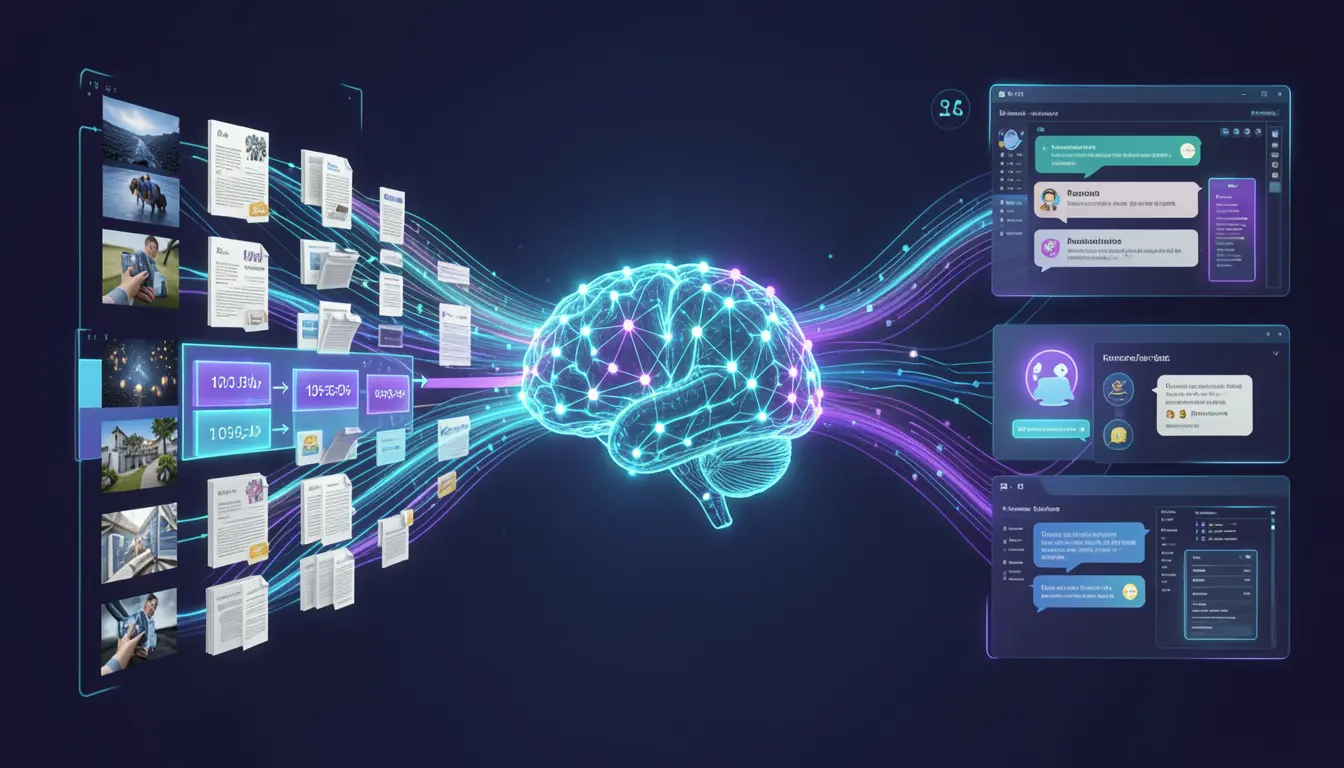
Billions of people interact with artificial intelligence every single day — through their phones, their search engines, their social media feeds, their bank accounts, and their home devices. Yet when most people are asked how AI actually works, the honest answer is: they have no idea. The technology feels like magic, or worse, like something deliberately kept mysterious by the people who build it.
It is neither. The core principles behind how AI works are genuinely understandable by anyone willing to spend a little time with them. You do not need a mathematics degree or a programming background to grasp what is really happening inside an AI system. What you need is a clear explanation that starts from the beginning and builds honestly, without shortcuts or hand-waving.
That is exactly what this guide provides.
The Fundamental Idea: Learning From Examples
The single most important thing to understand about how modern AI works is that it learns from examples rather than following hand-written rules. This is what separates AI from traditional software and is the key to understanding almost everything else about how the technology operates.
Think about how a child learns to recognize a dog. Nobody sits down and gives the child an exhaustive written description of every possible dog — all the different breeds, sizes, colors, and postures a dog might have. Instead, the child simply sees many dogs in real life, in books, in photographs and on screens. Over time, through exposure to many examples, the child’s brain builds an internal model of what makes something a dog. The child then applies that model to new situations — spotting a dog in a park they have never visited, or identifying a breed they have never seen before — and does so effortlessly.
Modern AI works in a remarkably similar way. Instead of a programmer writing explicit rules — if the object has four legs, fur, a tail, and barks, then it is a dog — an AI system is shown enormous numbers of examples (images of dogs and not-dogs, labeled accordingly) and learns its own internal rules for making the distinction. The AI’s version of those rules is not written in human language. It is encoded in the mathematical parameters of the model. But the learning process is conceptually very similar to how a child learns from experience.
This approach — learning patterns from data rather than following explicit instructions — is called machine learning, and it is the engine at the heart of virtually every AI system in use today.
What Training Data Actually Is
Every AI system needs data to learn from. This data is called training data, and its quality, quantity, and diversity are arguably the most important factors in determining how well an AI system ultimately performs.
Training data for an image recognition system might consist of millions of photographs, each labeled with what it contains. Training data for a language model might consist of hundreds of billions of words of text drawn from books, websites, academic papers, and other written sources. Training data for a fraud detection system might consist of millions of past financial transactions, each labeled as either legitimate or fraudulent.
The AI system processes this training data and looks for patterns — statistical regularities that allow it to distinguish between categories, make predictions, or generate outputs. The more high-quality, representative training data a system has, the better it tends to perform. This is why the organizations building the most capable AI systems invest enormous resources in collecting and curating data.
Training data also introduces one of the most significant challenges in AI development: bias. If the training data does not accurately represent the real world — if it over-represents certain groups of people, certain types of situations, or certain perspectives — the AI system will learn a skewed model of reality and produce biased outputs. Understanding that AI learns from data, and that data reflects the world as it has been rather than as it should be, is essential to understanding both the power and the limitations of AI systems.
Neural Networks: The Architecture Behind Modern AI
The specific type of machine learning that powers most of today’s impressive AI systems is called deep learning, and it is built on structures called neural networks. Understanding neural networks — even at a basic level — unlocks a much clearer picture of how AI actually operates.
A neural network is a computational structure loosely inspired by the human brain. The brain consists of billions of neurons — nerve cells that transmit electrical signals to one another through connections called synapses. The strength of these connections changes over time based on experience, which is the physical basis of learning and memory.
An artificial neural network mimics this structure in a simplified mathematical form. It consists of layers of artificial neurons — in practice, just numbers that perform mathematical operations. These neurons are organized into an input layer (which receives the raw data), one or more hidden layers (which transform and process the data), and an output layer (which produces the final result). Each connection between neurons has a weight — a number that determines how much influence one neuron has on the next.
When data flows through the network — an image, a sentence, a set of numbers — it is transformed at each layer. The transformations extract increasingly abstract features. In an image recognition network, the first layers might detect simple features like edges and color gradients. Middle layers might detect shapes and textures. Later layers might detect higher-level concepts like eyes, ears, or faces. By the final layer, the network has processed the raw data into a form that allows it to make a confident classification.
The word “deep” in deep learning refers to the depth of these networks — the number of hidden layers they contain. Modern large AI models can have hundreds of layers and billions or even trillions of individual parameters (the weights on the connections between neurons). The scale of these systems is genuinely staggering, which is why training them requires enormous amounts of computing power.
The Training Process Step by Step
Training a neural network is the process of adjusting all those billions of parameters until the network produces accurate outputs. Here is how it works in practice.
The network starts with all its parameters set to random values. It is then shown a training example — say, an image of a cat — and asked to produce an output (a prediction about what the image contains). Because the parameters are random, the initial prediction is essentially random too and almost certainly wrong.
The network’s prediction is then compared to the correct answer, which is known because the training data is labeled. The difference between the prediction and the correct answer is called the loss or error. The goal of training is to minimize this loss across all the training examples.
To reduce the loss, the training algorithm calculates how much each parameter in the network contributed to the error — a process called backpropagation. It then adjusts each parameter slightly in the direction that would have reduced the error — a process called gradient descent. The adjustments are tiny, but the process is repeated for every training example, often multiple times through the entire dataset.
After training on millions of examples with billions of small adjustments, the parameters gradually settle into values that allow the network to make accurate predictions. The network has, in a meaningful sense, learned. The knowledge is not stored in rules or facts that a human could read. It is encoded in the specific configuration of all those billions of numerical parameters.
How AI Makes Decisions and Generates Outputs
Once a neural network is trained, using it to make predictions or generate outputs is called inference. During inference, new data — data the network has never seen before — is fed through the network. The learned parameters transform the input through each layer and produce an output.
For a classification task like image recognition, the output might be a list of probabilities: 94% cat, 3% dog, 2% rabbit, 1% other. The system selects the category with the highest probability as its answer.
For a language model like those powering modern AI chatbots, the process is somewhat different. These models are trained to predict the next word in a sequence, given all the words that came before. During inference, the model takes the user’s input, predicts the most appropriate next word, adds that word to the sequence, predicts the next word again, and continues this process word by word until it has generated a complete response. The result can look strikingly like coherent, thoughtful text — because the model has learned from so much human writing that it has internalized the statistical patterns of coherent, thoughtful communication.
This word-by-word prediction process is why language models can sometimes produce plausible-sounding but factually incorrect statements. The model is optimizing for linguistic coherence — producing text that sounds right, based on the patterns it learned — not for factual accuracy per se. Understanding this is crucial to using AI language tools wisely.
Reinforcement Learning: Teaching AI Through Rewards
Not all AI systems learn from labeled examples. Another important approach is reinforcement learning, where an AI system learns by interacting with an environment and receiving rewards or penalties based on the outcomes of its actions.
The most famous demonstration of reinforcement learning came when AI systems learned to play complex games — first simple games, then chess, then the ancient board game Go, which has more possible positions than there are atoms in the observable universe. In each case, the AI was not told how to play. It was simply given the rules, allowed to play millions of games against itself, and rewarded for winning. Through this process, it discovered strategies that no human had ever conceived.
Reinforcement learning is also used to fine-tune language models after their initial training, in a process called reinforcement learning from human feedback (RLHF). Human evaluators rate the model’s responses for quality, helpfulness, and safety. The model is then adjusted to produce responses more like those rated highly. This is a key part of how AI assistants are made to be genuinely useful and appropriately safe in practice.
The Role of Scale: Why Bigger Models Work Better
One of the most surprising and important discoveries in recent AI research is that simply making models bigger — giving them more parameters and training them on more data — tends to make them dramatically more capable, often in ways that were not specifically programmed or anticipated.
This phenomenon, sometimes called emergent capability, has been observed repeatedly as AI models have grown in scale. Language models that cross certain size thresholds suddenly become capable of tasks like basic arithmetic, logical reasoning, and following complex multi-step instructions — tasks they could not perform at smaller scales, even with the same training approach.
The reason for this is not fully understood, which is itself one of the most interesting and important unsolved questions in AI research. What is clear is that scale matters enormously, which is why the most capable AI systems require massive infrastructure to train and run — thousands of specialized computer chips, enormous data centers, and energy consumption on the scale of small cities.
What Happens Inside AI That We Cannot See
One of the most important and often misunderstood aspects of how AI works is that even the people who build these systems do not fully understand what is happening inside them. When a neural network produces an output, the path from input to output passes through billions of mathematical transformations. Tracing exactly why the network produced that specific output — which features it was responding to, which learned associations influenced the result — is genuinely difficult and is the subject of an entire research field called AI interpretability or explainability.
This opacity has significant practical consequences. It is part of why AI systems can fail in unexpected ways — producing confidently wrong answers, behaving oddly when given unusual inputs, or exhibiting biases that were not anticipated during development. It is also why simply asking an AI system to explain its reasoning does not always produce a reliable explanation — the verbal explanation is itself generated by the same statistical prediction process, not by direct introspection of the underlying computation.
Understanding this limitation is not a reason to distrust AI entirely. It is a reason to use AI thoughtfully — to treat its outputs as highly useful inputs to human judgment rather than as infallible answers, and to maintain appropriate human oversight in any situation where the stakes are high.
From Raw Model to Useful Tool: What Happens After Training
Training a model is only part of the process of building a useful AI system. After the core model is trained, it typically goes through extensive evaluation — testing its performance on data it has not seen before to measure how well it generalizes. It is then fine-tuned for specific tasks or use cases, often using smaller specialized datasets and techniques like RLHF mentioned earlier.
Safety testing is a critical part of this process — trying to identify ways the model might produce harmful, biased, or misleading outputs and putting in place guardrails to prevent or reduce those problems. This is an imperfect process. No AI system can be made perfectly safe, and the guardrails that work well for anticipated problems may fail in ways that were not anticipated.
The trained and evaluated model is then deployed — made available through an interface or API that allows users and applications to send it inputs and receive outputs. The infrastructure required to serve a large AI model to millions of users simultaneously is itself a major engineering challenge, requiring specialized hardware optimized for the specific mathematical operations that neural networks perform.
When you type a question into an AI chatbot and receive an answer in seconds, what you are experiencing is the end result of this entire pipeline — training data collected and processed, a model with billions of parameters trained over weeks or months on thousands of specialized chips, fine-tuned and evaluated, deployed on a global infrastructure, and serving your specific request in real time. The apparent simplicity of the experience conceals an enormous amount of engineering and scientific work.
Why Understanding This Matters
Knowing how AI works changes how you use it. When you understand that a language model is producing text by predicting statistically likely continuations based on its training data, you immediately understand why you should verify important factual claims it makes rather than taking them at face value. When you understand that an AI system’s behavior is determined by its training data, you understand why AI tools trained primarily on data from certain countries or languages may work less well for other populations. When you understand that AI systems optimize for the objectives they were trained on, you understand why they can perform impressively on tasks similar to their training while failing strangely on tasks that are slightly outside their training distribution.
This understanding also makes the technology less intimidating. AI systems are not mysterious oracles or digital minds. They are extraordinarily sophisticated pattern-matching systems, built from data and mathematics, capable of remarkable things within their training domain and prone to specific, predictable types of failure outside it. Knowing this allows you to use them as what they are — powerful tools — rather than treating their outputs as either magical or unreliable.
Frequently Asked Questions
Does AI understand what it says?
Not in the way humans understand things. AI language models produce text by predicting statistically likely word sequences based on patterns learned from training data. They do not have comprehension, awareness, or genuine understanding of meaning. They can produce text that appears deeply knowledgeable because they have processed enormous amounts of human knowledge, but the underlying process is pattern matching rather than understanding.
How long does it take to train an AI model?
Training times vary enormously depending on the size of the model and the amount of training data. Small models can be trained in hours or days. Large language models of the kind powering modern AI assistants can take weeks or months of continuous training on thousands of specialized chips. The computational cost is one of the major reasons that only a small number of organizations have the resources to train the largest AI models from scratch.
Why does AI sometimes give wrong answers confidently?
Because AI language models are trained to produce coherent, confident-sounding text, not to flag their own uncertainty. The model has no internal mechanism for distinguishing between things it knows reliably and things it is effectively guessing about. It will produce both accurate information and plausible-sounding misinformation with the same confident tone. This is why human verification of AI outputs remains important for any factual claim that matters.
Is AI the same in all applications?
No. Different AI applications use different types of models, trained on different data, optimized for different tasks. The AI in a medical imaging system is fundamentally different from the AI in a language chatbot, which is different again from the AI in a fraud detection system or a recommendation engine. What they share is the general approach of learning from data using machine learning techniques.
Can AI improve itself without human input?
Current AI systems do not improve themselves autonomously in the way science fiction often depicts. Improving an AI system requires deliberate human effort — collecting more or better training data, adjusting the training process, modifying the model architecture, or running additional fine-tuning. Some systems can update in limited ways based on new data, but fundamental improvement requires human involvement. Research into AI systems that can improve themselves more autonomously is an active area, with significant safety implications that researchers are carefully working through.
