
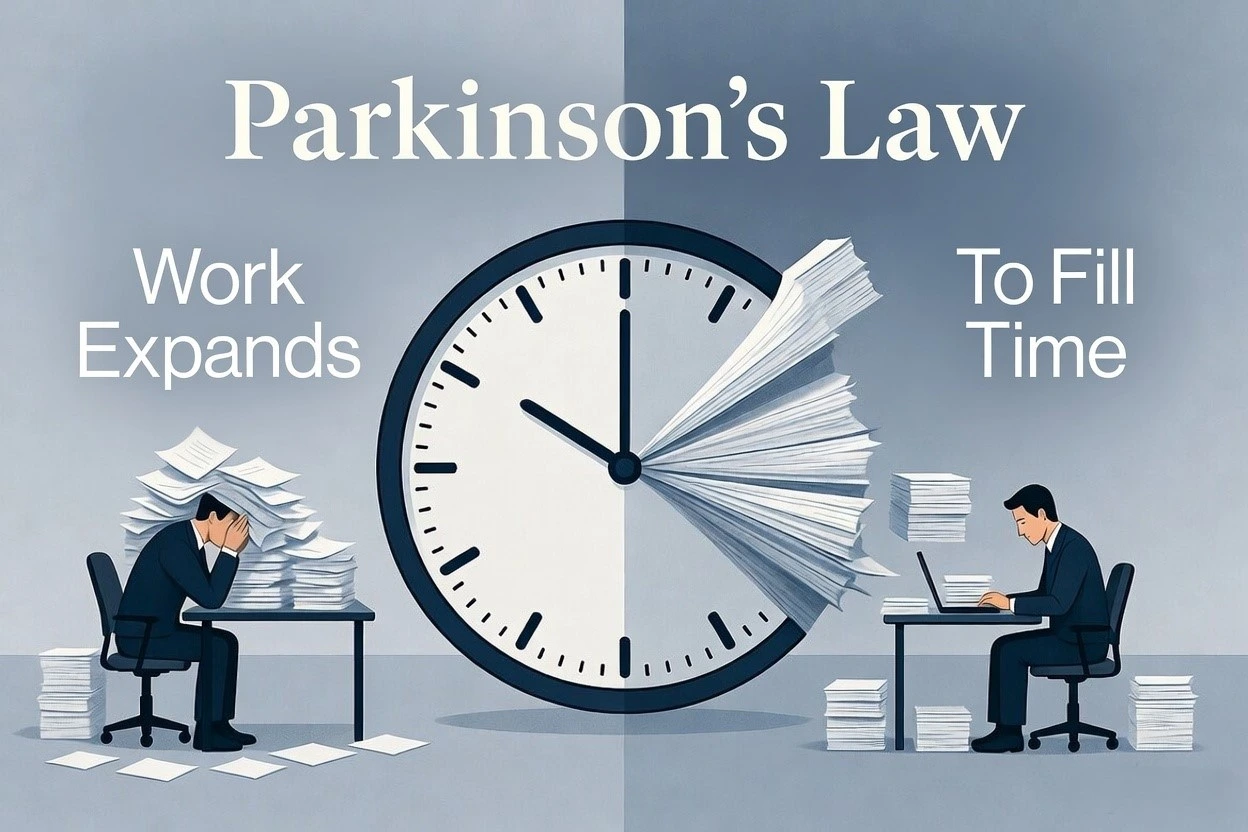
We often assume that giving ourselves more time will lead to better work.
More time should mean less stress, better planning, and higher-quality results. Yet reality often suggests the opposite. A task that could be completed in an hour somehow consumes an entire afternoon. A project with a six-month deadline stretches until the final week. Meetings scheduled for an hour rarely finish in thirty minutes, even when they easily could.
This observation is captured by a famous principle known as Parkinson’s Law:
“Work expands so as to fill the time available for its completion.”
Though simple, the idea reveals something important about human behavior, productivity, and the way organizations function.
Where Did Parkinson’s Law Come From?
Parkinson’s Law was proposed by British historian and author Cyril Northcote Parkinson in 1955.
While studying government bureaucracies, Parkinson noticed a peculiar pattern. Administrative departments continued to grow larger even when the amount of actual work remained unchanged—or in some cases, even decreased.
His explanation was not that governments were becoming more productive. Rather, people naturally created additional procedures, paperwork, meetings, and responsibilities that justified their existence.
What began as a humorous observation eventually became one of the most widely cited principles in productivity and management.
Although Parkinson originally applied the concept to bureaucracy, it quickly became clear that the same tendency appears almost everywhere.
What Does Parkinson’s Law Actually Mean?
At its core, Parkinson’s Law suggests that the amount of time available influences the amount of work we perceive.
When a task has a generous deadline, people often:
- Delay starting
- Spend more time planning than necessary
- Add unnecessary complexity
- Revise repeatedly
- Focus on minor details
The task expands until it occupies the entire time allotted.
By contrast, when the same task must be completed quickly, people focus on what truly matters and eliminate distractions.
The work itself may not be larger. The available time simply changes our behavior.
A Simple Example
Imagine you need to write a two-page report.
If your manager asks for it by the end of the day, you might gather the necessary information, write the report, edit it once, and submit it within a few hours.
Now imagine the deadline is one month away.
Suddenly the process looks very different. You may spend days collecting extra information, repeatedly reorganize the document, revise sections that were already acceptable, and postpone completion until the final week.
The report is still only two pages long.
What changed was not the work—it was the time available.
Why Does This Happen?
Parkinson’s Law persists because it aligns with several common psychological tendencies.
Procrastination
When a deadline feels distant, there is little pressure to begin immediately.
People often convince themselves there will always be enough time later.
Perfectionism
Additional time creates opportunities for endless refinement.
Rather than completing a task, people continue making minor improvements that add little value.
Complexity Bias
Humans often equate effort with quality.
Given extra time, we may unconsciously make tasks more complicated than they need to be.
Lack of Urgency
Urgency forces prioritization.
Without it, attention drifts toward less important activities.
Parkinson’s Law in Organizations
The principle becomes even more visible within large organizations.
Consider a committee assigned six months to solve a problem.
The group may schedule numerous meetings, prepare lengthy reports, conduct multiple reviews, and spend significant time discussing details that have little impact on the final outcome.
A smaller team facing a shorter deadline may arrive at a similar solution much faster.
This does not mean speed is always better. Complex problems genuinely require time.
However, Parkinson’s Law reminds us that organizations often confuse activity with progress.
More meetings do not necessarily produce better decisions.
More paperwork does not necessarily create better outcomes.
More time does not necessarily improve results.
The Hidden Cost of Excess Time
Many people think time is always an advantage.
Yet excessive time can create hidden costs.
Projects become bloated.
Decisions are postponed.
Resources are consumed unnecessarily.
Opportunities are missed while people continue refining work that was already good enough.
In extreme cases, organizations become trapped in cycles of planning and discussion without meaningful action.
The longer the timeline, the easier it becomes to justify delays.
Does Parkinson’s Law Mean Deadlines Should Always Be Short?
Not exactly.
The lesson is not that every task should be rushed.
Some projects require research, experimentation, collaboration, and careful consideration.
The real insight is that constraints often improve focus.
A realistic deadline encourages people to prioritize what matters most.
Without constraints, work can expand indefinitely.
The goal is not to eliminate time but to avoid giving so much of it that efficiency disappears.
How to Use Parkinson’s Law to Your Advantage
Understanding the principle allows you to work with it rather than against it.
Set Shorter Deadlines
Many tasks can be completed faster than we initially assume.
Artificially reducing available time often increases focus.
Break Large Projects Into Smaller Deadlines
Instead of one distant deadline, create several milestones.
This prevents work from expanding unchecked.
Limit Meetings
Shorter meetings encourage participants to concentrate on important issues.
Focus on Outcomes
Ask whether an activity improves the final result or simply consumes time.
Accept “Good Enough”
Perfection is often the enemy of completion.
Many tasks reach diminishing returns long before they are considered finished.
Criticisms of Parkinson’s Law
Like most principles, Parkinson’s Law is not universal.
Some work genuinely benefits from additional time.
Creative projects, scientific research, and complex engineering problems often require patience and iteration.
The law is best understood as a tendency rather than an absolute rule.
Its value lies in highlighting a common pattern: people frequently use all the time they are given, whether they need it or not.
Why Parkinson’s Law Still Matters
More than seventy years after it was first proposed, Parkinson’s Law remains relevant because it describes a recurring feature of human behavior.
Technology has made many tasks faster than ever before, yet people often feel busier than previous generations.
Part of the reason is that new efficiencies do not always reduce workloads. Instead, expectations expand to fill the available capacity.
The same principle that once explained bureaucratic growth now helps explain overflowing inboxes, endless meetings, and projects that never seem finished.
Understanding Parkinson’s Law encourages a simple but powerful question:
If less time were available, would this task really need to be done this way?
Often, the answer reveals opportunities for greater focus, efficiency, and productivity.
Key Takeaways
- Parkinson’s Law states that work expands to fill the time available for its completion.
- The concept was introduced by Cyril Northcote Parkinson in 1955.
- Longer deadlines often encourage procrastination, perfectionism, and unnecessary complexity.
- Organizations frequently experience Parkinson’s Law through bureaucracy, meetings, and administrative growth.
- Reasonable constraints can improve focus and efficiency.
- The principle is not about rushing work but about preventing unnecessary expansion.
Frequently Asked Questions
What is Parkinson’s Law?
Parkinson’s Law is the idea that work naturally expands to fill the time available for completing it.
Who created Parkinson’s Law?
The concept was introduced by British historian and author Cyril Northcote Parkinson in 1955.
Is Parkinson’s Law scientifically proven?
It is not a formal scientific law, but numerous observations in productivity, management, and psychology support the underlying principle.
How can I avoid Parkinson’s Law?
Setting shorter deadlines, creating milestones, limiting unnecessary meetings, and focusing on outcomes can help prevent work from expanding unnecessarily.
Does Parkinson’s Law apply to organizations?
Yes. It is often observed in businesses, government agencies, and large institutions where procedures and administrative work tend to grow over time.
