
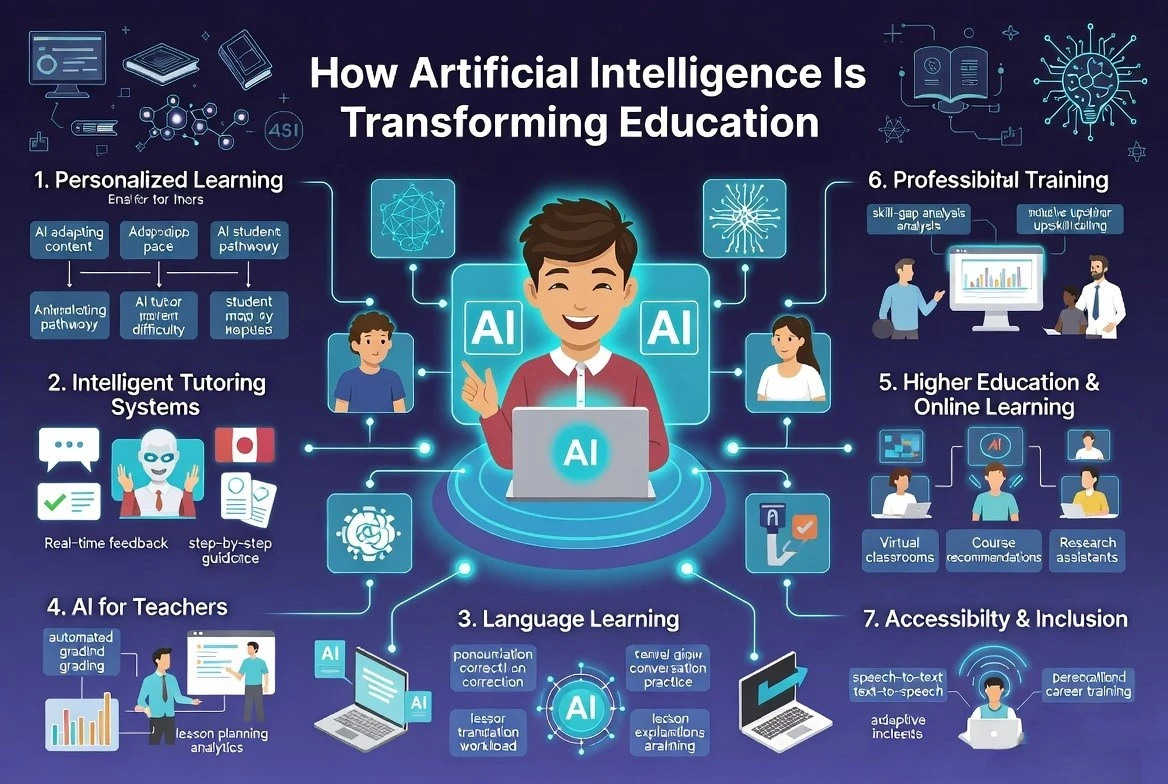
Education has always evolved with the tools available to it. The printing press made books affordable and literacy widespread. The internet made information universally accessible and created new forms of self-directed learning. Artificial intelligence represents the next transformation — one that is already underway in classrooms, universities, corporate training programs, and self-study platforms around the world. This transformation has the potential to be the most profound in history, because AI can do something no previous educational technology could: adapt in real time to the individual needs of each learner.
The promise of personalized education — teaching each student in the way that works best for them, at the pace that suits them, with the level of challenge that keeps them engaged without overwhelming them — has existed for as long as education itself. Great teachers have always tried to personalize instruction for their students. But with thirty students in a classroom and a fixed curriculum to cover, the reality of mass education has always fallen far short of the ideal. AI has the potential to close this gap, and the early evidence suggests it is already doing so in meaningful ways.
Table of Contents
Personalized Learning: The Core Promise of AI in Education
The most significant contribution AI makes to education is the ability to personalize learning at scale. Personalized learning means that the content, pace, difficulty, and format of instruction are adapted to the specific needs, strengths, and gaps of each individual learner, rather than being delivered identically to everyone in a class.
AI-powered adaptive learning systems do this by continuously analyzing how a learner responds to different types of content and questions. When a student answers a question correctly and quickly, the system infers that the underlying concept is well understood and advances to more challenging material. When a student answers incorrectly or takes a long time, the system infers that the concept needs more reinforcement and provides additional explanation, worked examples, or different types of practice. Over time, the system builds a detailed model of each learner’s knowledge state and uses it to make moment-by-moment decisions about what content to present next.
This kind of continuous, responsive adaptation is impossible for a human teacher managing a full classroom. An AI tutoring system can give each of thirty students a completely different learning experience, simultaneously, without fatigue, without favoritism, and available at any hour of the day. The student who learns mathematical concepts quickly can race ahead to more advanced material. The student who needs more time can receive additional support without feeling embarrassed or holding back the class. The student who understands the concept but struggles with calculation can receive targeted practice on the specific skill that needs work.
Research on adaptive learning systems has produced encouraging results. Studies of AI tutoring systems in mathematics and reading have found learning gains that are meaningfully larger than those produced by conventional instruction alone. When AI tutoring is used to supplement rather than replace human teachers — providing personalized practice outside the classroom while freeing teachers to focus on higher-level instruction, discussion, and mentorship inside it — the combination appears to be particularly effective.
Intelligent Tutoring Systems
Intelligent tutoring systems (ITS) are AI-powered educational applications designed to provide the kind of individualized instruction and feedback that a skilled human tutor provides. They go beyond simple adaptive difficulty adjustment to model a learner’s understanding in detail, identify specific misconceptions, and respond to them with targeted instruction.
The best intelligent tutoring systems maintain a knowledge model of each student — a representation of which concepts the student understands, which they are in the process of learning, and which they have not yet encountered. As the student works through problems and exercises, the system updates this model based on the student’s responses, including not just whether answers are correct but how long they take, which types of errors are made, and whether performance improves with practice.
Cognitive Tutor, developed by Carnegie Mellon University, is one of the most extensively studied intelligent tutoring systems. Used for mathematics instruction from middle school through college, it models each student’s proficiency at dozens of specific mathematical skills and continuously adjusts the problems it presents to focus practice on the skills where each student most needs it. Controlled studies have consistently found that students using Cognitive Tutor learn significantly more than students receiving conventional instruction, and the system has been deployed to millions of students.
Modern intelligent tutoring systems increasingly incorporate natural language processing to allow students to interact with them conversationally — asking questions, explaining their reasoning, and receiving responses that address their specific confusions. This conversational capability makes the interaction more natural and allows the system to diagnose misunderstandings that would not be apparent from answer correctness alone.
AI in Language Learning
Language learning is one of the areas where AI has had the most visible and widespread impact on everyday education. Applications like Duolingo, Babbel, and Rosetta Stone have used AI for years to adapt lesson difficulty and content to each learner’s progress, and the most recent generation of language learning tools incorporates far more sophisticated AI capabilities.
AI speech recognition allows language learning apps to evaluate pronunciation with precision that was previously available only from trained human teachers. The app can detect not just whether a word was recognizable but the specific phonetic errors the learner is making and provide targeted feedback. Over thousands of practice repetitions, the learner gets precise, consistent feedback on their pronunciation that gradually shapes it toward native-speaker norms.
Spaced repetition systems use AI to schedule vocabulary review at the optimal times to maximize long-term retention. The forgetting curve — the rate at which newly learned information is lost without review — is well-established in cognitive psychology. Spaced repetition systems model each learner’s forgetting curve for each vocabulary item and schedule reviews at precisely the right intervals to reinforce memory just before it would otherwise fade. This allows learners to maintain large vocabularies with far less review time than would be required with conventional study methods.
Large language models have created new possibilities for language practice that did not previously exist for most learners. Conversational AI can now provide virtually unlimited practice in the target language, responding to anything the learner says or writes, correcting errors, introducing new vocabulary in context, and adjusting the complexity of the conversation to the learner’s level. This kind of extensive conversational practice was previously available only to learners with access to native speakers or expensive tutors.
AI Tools for Teachers
The impact of AI on education is not limited to direct interactions with learners. AI is also transforming the work of teachers themselves, automating time-consuming administrative tasks, providing new analytical tools, and enabling new forms of differentiated instruction.
Automated grading is one of the most immediately impactful AI tools for teachers. AI systems can now grade not just multiple-choice questions but short written responses, extended essays, and even code written by students. While AI grading of extended writing remains imperfect and controversial, AI can reliably handle the grading of standardized short-answer questions and provide a first pass on essays that teachers then review and refine. The time savings can be significant, particularly for teachers with large classes or heavy grading loads.
Learning analytics platforms use AI to analyze data from learning management systems, assessment tools, and classroom activities to identify patterns that might not be visible to individual teachers. Which students are at risk of falling behind? Which concepts are most students struggling with? Which instructional activities correlate with the best learning outcomes? These questions can be answered with greater precision when AI is analyzing data across thousands of students and interactions.
AI content generation tools can help teachers create instructional materials — lesson plans, practice problems, explanations at different reading levels, assessment questions — much more quickly than they could produce them from scratch. A teacher can describe what they want and receive a draft in seconds, which they then review and adapt. This can meaningfully reduce the time teachers spend on preparation and increase the variety and quality of materials available to their students.
AI in Higher Education and Professional Learning
The impact of AI on education extends beyond K-12 schooling to universities, professional training, and lifelong learning. In higher education, AI tools are being used for automated feedback on student writing, AI-powered research assistance, intelligent library systems that help students find relevant sources, and plagiarism detection that has evolved to also detect AI-generated content.
Online learning platforms like Coursera, edX, and Khan Academy use AI to personalize the learning experience for millions of learners globally, recommending courses based on career goals and learning history, adjusting content difficulty, and providing targeted feedback on assignments. These platforms have made high-quality educational content from leading universities accessible to anyone with an internet connection, and AI personalization makes that content more effective for each individual learner.
Corporate training and professional development have been transformed by AI-powered learning management systems that can identify skill gaps in a workforce, recommend targeted training to address those gaps, and track learning progress across organizations. As the pace of change in many industries accelerates and the skills required in jobs evolve more rapidly, the ability to deliver timely, targeted, personalized learning at scale becomes increasingly valuable.
The Real Challenges and Limitations
The potential of AI in education is genuinely exciting, but it is important to engage honestly with the challenges and limitations as well. AI tutoring systems, however sophisticated, cannot fully replicate the relationship between a skilled human teacher and their students. The motivational, emotional, and social dimensions of learning — the encouragement a teacher provides to a struggling student, the excitement a passionate educator brings to a subject, the collaboration and discussion between peers in a classroom — are not things AI can provide. Education is a fundamentally human activity, and AI is a tool to augment it, not replace it.
Equity concerns are also significant. AI-powered educational tools require devices and reliable internet connectivity, which are not universally available. The risk is that AI in education widens rather than narrows educational inequality, providing powerful personalized learning to students in well-resourced environments while remaining inaccessible to those in underserved communities. Addressing this requires deliberate policy choices and investment in educational infrastructure, not just in AI tools.
Data privacy is another serious concern. Effective AI tutoring requires collecting detailed data about how students learn, what they struggle with, and how they progress over time. This data is sensitive, particularly when it involves minors. The collection, storage, and use of student data must be governed by robust legal protections and institutional policies that prioritize student privacy and prevent misuse.
The question of AI-generated content and academic integrity is also actively being worked through by educational institutions. When AI can generate a plausible essay on any topic in seconds, traditional essay assignments as assessments of student learning are disrupted. Educators are rethinking assessment design — moving toward forms of evaluation that AI cannot easily substitute for, like oral examinations, in-class writing, project-based learning, and demonstrations of applied skills.
Frequently Asked Questions
Will AI replace teachers?
No. AI can automate certain aspects of teaching — delivering personalized practice, grading routine assignments, identifying students at risk — but it cannot replace the fundamentally human dimensions of education. Great teaching involves motivation, inspiration, relationship, emotional attunement, and the kind of deep subject expertise combined with pedagogical skill that shapes how students think and who they become. AI is best understood as a tool that can free teachers from time-consuming routine tasks so they can focus more on the distinctly human aspects of their work.
Is AI tutoring as effective as human tutoring?
The research suggests that AI tutoring is significantly more effective than conventional classroom instruction but generally somewhat less effective than skilled one-on-one human tutoring. However, skilled one-on-one human tutoring is expensive and unavailable to most learners. AI tutoring can provide a level of personalized instruction that is close to one-on-one tutoring to anyone with a device and internet connection, at a fraction of the cost. For most learners in most contexts, AI tutoring represents a significant improvement in the quality of educational support available to them.
Can AI help children with learning differences?
Yes, significantly. AI-powered educational tools can adapt to a much wider range of learning styles and needs than conventional instruction. Text-to-speech and speech-to-text tools support learners with reading and writing difficulties. Adaptive pacing and difficulty adjustment help learners with attention or processing challenges. Real-time translation supports learners who are not proficient in the language of instruction. AI has the potential to make education more genuinely inclusive for learners whose needs are not well-served by one-size-fits-all approaches.
How should students use AI tools ethically?
The ethical use of AI in education involves using AI tools to enhance learning rather than to circumvent it. Using AI to generate explanations of difficult concepts, to get feedback on draft writing, to practice skills, and to explore ideas is educationally valuable. Using AI to produce work that is then submitted as your own without genuine engagement represents a form of academic dishonesty that undermines the purpose of education. The distinction is whether AI is being used as a learning tool or as a substitute for learning.
What is the future of AI in education?
The trajectory points toward AI becoming deeply integrated into every aspect of education — not as a replacement for human educators but as a pervasive support infrastructure that makes learning more personalized, more accessible, and more effective for every learner. The most significant near-term developments are likely in conversational AI tutoring, which is becoming capable enough to support rich educational dialogue across almost any subject; in learning analytics, which will give educators unprecedented insight into how their students learn; and in the tools that help educators design better learning experiences and assessments. The institutions that navigate the integration of AI thoughtfully — capturing its genuine benefits while addressing its real risks — will be best positioned to prepare their students for a world in which AI is pervasive.
