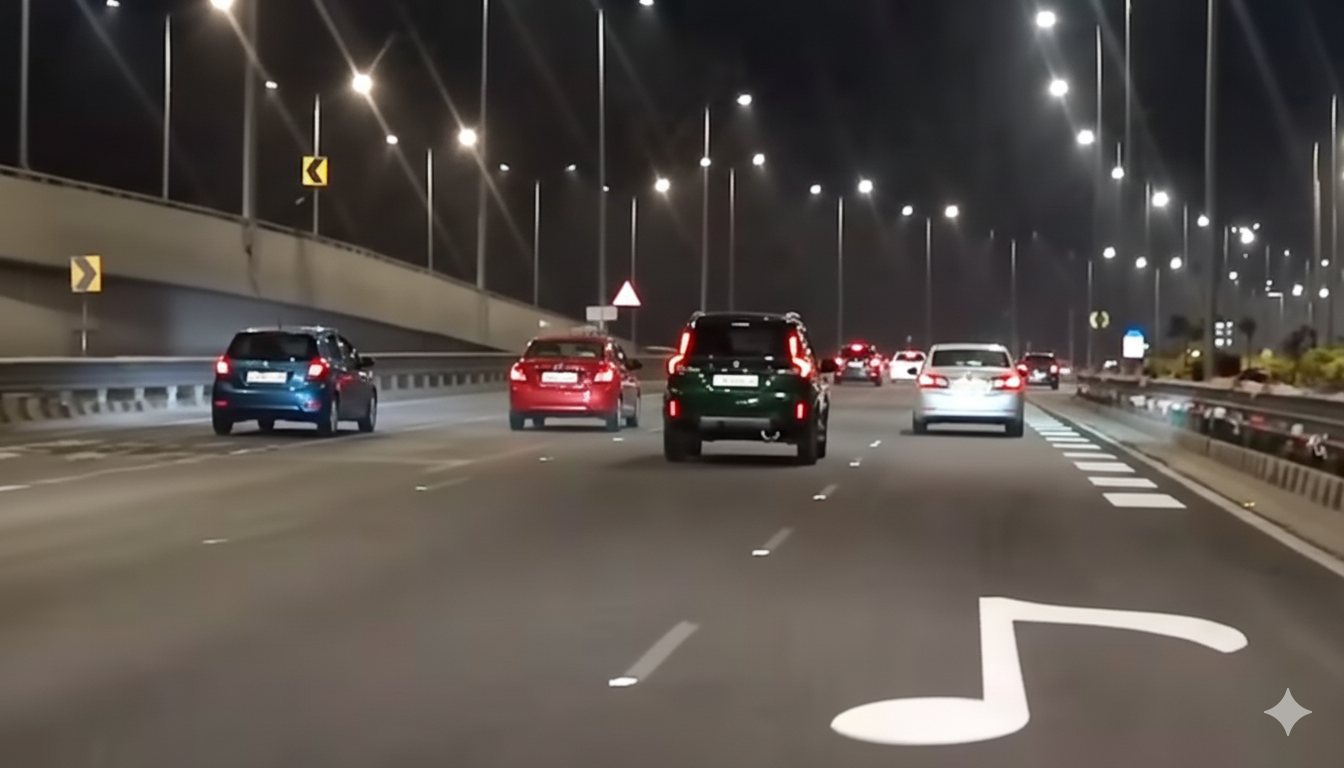
In February 2026, Mumbai’s Coastal Road made national headlines by introducing an unprecedented road feature: a musical stretch that produces the iconic tune “Jai Ho” from the film Slumdog Millionaire as vehicles pass over it at specific speeds. This initiative represents a fascinating blend of civil engineering, experience design, speed management and cultural expression. It marks the first musical road in India, transforming a functional segment of urban infrastructure into an interactive auditory experience.
This comprehensive article explores what musical roads are, how the Mumbai installation works, why “Jai Ho” was chosen, the engineering behind it, how it aligns with global examples, and the broader implications — including potential benefits and public reactions.

What Is a Musical Road?
A musical road (also known as a melody road) is a specially engineered stretch of roadway designed to produce melodic sounds when vehicles drive over it at particular speeds. Unlike typical road rumble strips — which are used purely for safety warnings — musical road grooves are spaced in such a way that the vibrations generated by tyre interaction produce specific tones and sequences, forming a recognisable tune.
This concept has been implemented in countries such as Japan, Hungary, South Korea, the United States, China and the United Arab Emirates, where it has been used for entertainment, driver engagement or safety reinforcement. The technology has its origins in experiments with groove spacing and tyre vibration physics, and has evolved into roadway design features that merge practicality with novelty.
In India, the musical road is a pilot initiative, bringing international road innovation to a local urban expressway. The Mumbai installation is a 500‑metre stretch located on the northbound lane from Nariman Point towards Worli, immediately after the underground tunnel by Breach Candy.
Why Mumbai’s Coastal Road?
Mumbai’s Coastal Road Project is one of the largest and most important urban infrastructure achievements in India, reducing travel times between South Mumbai and suburban regions, and connecting key traffic conduits. The addition of a musical road enriches the commuter experience on what is already one of the city’s most iconic arterial routes.
The project was officially inaugurated on 11 February 2026, with Maharashtra Chief Minister Devendra Fadnavis and Deputy Chief Minister Eknath Shinde in attendance. Dignitaries including representatives from the Brihanmumbai Municipal Corporation (BMC) and participating experts also experienced the musical stretch firsthand.
By integrating this feature on the Coastal Road, Mumbai has not only added a novelty to daily commutes but also positioned itself in a select group of global cities utilizing highway infrastructure for experiential innovation.
The Tune: Why “Jai Ho”?
The melody installed on Mumbai’s musical road is “Jai Ho”, the iconic song from the internationally acclaimed film Slumdog Millionaire. The song, composed by A.R. Rahman, with lyrics by Gulzar, won the Academy Award for Best Original Song and a Grammy, and is widely recognised as a symbol of Indian cultural pride.
Choosing “Jai Ho” carries both emotional and cultural significance. The song’s popularity makes it instantly recognisable to a vast majority of commuters, and its upbeat, celebratory nature contributes to making the driving experience memorable. Officials and advocates of the project have highlighted that the tune’s patriotic resonance aligns well with the idea of showcasing Indian identity through infrastructure innovation.
Unlike a radio broadcast or speaker system, the melody is produced mechanically via road design and is typically heard inside the vehicle, especially with windows up — making it a personal experience rather than a public audio broadcast.
How Does the Musical Road Work?
At the heart of the musical road feature is precision engineering — specifically, the design and placement of grooves or rumble strips that interact with a vehicle’s tyres to create sound waves.
Groove Spacing and Vibration
The road surface incorporates a series of grooves cut at precise intervals and specific measurements. When a vehicle tyre rolls over these grooves, it produces vibrations which translate into sound waves. The spacing between grooves is calculated so that as the tyre makes contact at the correct speed, the frequency of vibrations corresponds to the notes of the intended tune.
This means the melody emerges mechanically — the road itself becomes the medium through which music is generated. No electronic audio systems or speakers are involved; instead, the tyre‑surface friction produces the requisite pattern of sound vibrations.
Speed Sensitivity and Tune Accuracy
An important aspect of the musical road is its speed dependency. The musical effect is calibrated to be heard clearly when vehicles travel at approximately 70–80 km/h. Speeds outside this range distort the sequence because the timing between vibration contacts changes, altering the pitch or rhythm of the perceived sound.
This speed sensitivity is central to the design: it encourages drivers to maintain a consistent, moderate speed, reinforcing safer driving practices while delivering the musical experience.
Road Signage and Motorist Guidance
To ensure commuters are prepared to hear the tune and adjust speed without sudden braking, warning signboards have been installed at multiple distances ahead of the musical stretch — commonly at 500 m, 100 m and 60 m before the start of the grooves. These signs serve both a safety and informational purpose, notifying motorists of the upcoming feature and the recommended speed range.
The result is a coordinated interaction between road design, vehicle speed and driver awareness — creating a structured and controlled way to experience the melody.
Engineering Foundations: Rumble Strips and Tonal Design
The technology behind musical roads relies on fundamental principles of acoustics and mechanical vibrations:
- Variable Groove Spacing: Different notes are created by altering the distance between grooves. Closer grooves generate higher frequency vibrations (higher pitch), while wider spacing creates lower pitches.
- Consistent Speed Input: Because the frequency of grooves encountered per second depends on speed, maintaining a consistent velocity is critical for the intended notes to form correctly.
- Tyre and Road Interaction: The tyre tread contacting the grooves acts as an intermediary — producing vibrations that travel through the vehicle body to be perceived as sound by occupants.
This concept is similar to how vinyl records work, where grooves encode audio information, but instead of a stylus tracing the groove, a rolling tyre generates the physical vibration.
Musical roads also use similar engineering principles as regular rumble strips, which are typically used to alert drivers who veer off lanes or approach hazards. In musical roads, however, the spacing and arrangement of grooves are intentionally designed for melody formation rather than safety alerts alone.
Global Context: Musical Roads Around the World
Mumbai’s musical road builds on a concept with global precedents. Japan, for instance, pioneered early musical road experiments in the early 2000s, where local road segments were adapted to play tunes when vehicles passed over them at specific speeds. Hungary later developed musical roads that became popular with drivers and tourists alike.
Elsewhere, cities in the United States, South Korea, China and the United Arab Emirates have experimented with similar installations. For example, a road in Fujairah (UAE) was designed to produce Beethoven’s Ode to Joy when driven at around 100 km/h. These examples illustrate how musical roads have been used to enhance driver engagement or contribute to local attractions and tourism appeal.
Mumbai’s version uses technology adapted from international expertise — including support from Hungarian specialists — and represents one of the few instances in Asia where musical road design has been applied on a major urban expressway.
Potential Benefits of Musical Roads
While the concept of musical roads may initially appear whimsical, there are several meaningful aspects worth noting:
Enhanced Driver Engagement
By introducing an unexpected sensory experience, the musical road can make routine commutes more engaging and memorable, enhancing overall road user experience.
Encouragement of Safe Speeds
Because the melody only forms at a specific speed range, the feature encourages drivers to maintain steady, moderate speeds rather than abrupt accelerations or slowdowns. This can assist in managing traffic flow on busy arterial routes.
Cultural Context and Tourism
Using an iconic Bollywood tune also adds a cultural dimension to infrastructure, reflecting regional identity and artistic expression. It can draw attention from tourists and automotive enthusiasts — creating a point of interest beyond pure functionality.
Innovation in Urban Infrastructure
The installation represents a broader trend toward creative urban solutions that integrate technology, public interaction and civic design — expanding how urban road networks serve both functional and experiential roles.
Public Perception and Critiques
As with many innovative public projects, the musical road has received a mix of reactions:
- Positive responses highlight the novelty, entertainment value and potential for safer speed compliance. Many commuters find hearing “Jai Ho” during a journey uplifting and engaging.
- Critiques focus on concerns around noise, distraction, cost and practicality. Some observers question whether novelty features should take precedence over fundamental road maintenance issues, while others warn that repeated exposure to road vibrations might distract drivers or generate unintended sound beyond the vehicle interior.
Social media discussions reflect this spectrum of opinion, ranging from enthusiastic praise to sceptical commentary about usefulness and implementation.
These divergent perspectives are typical for pioneering infrastructure projects — especially those that intersect technology with public experience.
Future of Musical Roads in India
Mumbai’s musical road could serve as a pilot model for similar installations in other cities if the concept proves successful and well received. Its combination of engineering, cultural expression and driver experience provides a template for how functional urban infrastructure can be enhanced with creative elements.
Future applications might explore different tunes, extended stretches, or context‑specific features that reflect local heritage or environmental themes. However, any expansion will need to consider traffic safety, urban soundscapes and long‑term maintenance.
Conclusion
The musical road on Mumbai’s Coastal Road stands as a compelling example of how infrastructure can evolve beyond utility into the realm of interactive design and cultural resonance. By enabling vehicles to “play” “Jai Ho” through tyre‑road interaction at specified speeds, this feature blends engineering precision with everyday experience in a way that is both innovative and distinctly Indian.
As cities around the world continue to experiment with creative uses of public space and technology, Mumbai’s initiative may inspire other urban centres to explore how even the most ordinary elements of transport infrastructure can be reimagined. Whether evaluated in terms of driver engagement, safety reinforcement or cultural symbolism, musical roads represent a fascinating intersection of sound, motion and urban life.